Showing posts with label Academia. Show all posts

Saturday, 12 October 2013

26 Signs You Were A History Major


 Yes, I'm a history major - and fiercely proud of it. Other people have master's degrees in things like communications, marketing, business administration etc. I have one in modern Japanese history and I've never regretted it - either personally or professionally. And as far as I may have strayed from the academic path as a historian, it's still in my blood. And if you too are an incurable historian, you'll probably recognize more than a few of these personality quirks.

1. Your Mexican holiday travel plans include the National Archives in Mexico City.
https://blogger.googleusercontent.com/img/b/R29vZ2xl/AVvXsEgn3-SaCN5zO_v4O34uCgFD-0hWburb06gjvnfQZphGCoSEXTCh8XuWIuUgQZ2eJklXEG7Dcnmbj6N2v5TVwqJucs9eNEnv-o6HiTsEcHKCgvEoEoFQnLgKtr2jmRvEW7zHKxmVARTTvVW6/s1600/nagn.gif
Source: archivista.blogspot.com


2. Your credit card and online banking PIN numbers are dates of battles or obscure treaties.

Source: @1066TheMovie


3. You edit Wikipedia content on a regular basis.

Source: blogs.ec.europa.eu


4. You acknowledged that the TV show Deadliest Warrior was a horrible show and you cringed while watching it - yet you continued to watch it religiously.

Source: sky.com


5. You've used Ancient Sparta and Alexander the Great as arguments in favour of gays in the military.

Source: chechar.wordpress.com


6. You get positively tetchy when people joke about the French being cheese-eating surrender monkeys and immediately bring up William the Conquerer, Napoleon Bonaparte, the Battle of Algiers and other examples of Gallic bellicosity.

Source: wikipedia.org


7. You actually know what the Latin motto of your university means - and you've tried to mess with people by making up obscene alternates to it.

Source: meanfellas.com

8. You've had sexual fantasies involving Queen Boudica. Or Abraham Lincoln.


Sources: http://tessfragoulis.files.wordpress.com / soulsmithy.com


9. You know that the "Meiji Restoration" isn't a digital data recovery function.


Source: bigglobe.ne.jp


10. You think the History Channel has sold out by pandering to religious zealots and conspiracy nuts and you scoff at its mere mention - and yet you continue to watch it.

Source: ascensionearth2012.com


11. When somebody asks you what historical figure you'd like to meet you can't give a straight answer, prefacing that it's a "complicated question."

Source: vivian-folkenflik.org


12. You wish that they would make a Star Wars movie set immediately after Return of the Jedi centred on the "Coruscant War Crimes Tribunals" wherein the surviving Imperial officers are tried for war crimes Nuremberg-style - and have actually thought about writing a piece of fan fiction along those lines.


Source: japantimes.com (originally)

13. You can't watch a sci-fi or fantasy movie without deconstructing it along the lines of what historical civilizations inspired it.

Source: comicvine.com / primeswormhole.blogspot.com

14. You've been on holiday in a foreign country and found yourself explaining the origins of place names in that country to people who live there.

Source: wikipedia.com


15. You know Napoleon wasn't really that short - and that he was actually an Italian guy named Napoleone di Buonaparte.

Source: blameitonthevoices.com


16. You've reached for a condom in a moment of passion and your mind immediately starts to fixate on how bad a name "Trojan" is for a condom given that the Trojans were indeed "impregnated" by the legendary wooden horse.

Source: seniorlearn.org

17. You "celebrate" Columbus Day by raging about colonialism and cultural genocide via social media.

Source: transformcolumbusday.org

18. You've used the word "historicity" in conversation without even realizing it.

Source: dayvidnightowl.wordpress.com


19. You know that the Iroquois Confederacy served as a model for the United States of America and its constitution - and was far ahead of the latter in racial and gender terms.

Source: fnx.org


20. New-age bookstores and alternative healing fairs make you angry - not for all the pseudoscience but for all the brazen cultural appropriation and modern inventions that purport to be "ancient knowledge and practices."

Source: fyeahcap.tumblr.com

21. You actually know what the Seven Wonders of the Ancient World are and get mad when people get them wrong.

Source: blog.wisdomjobs.com

22. You understand that Tintin au Congo, a comic book widely condemned for its caricatured portrayals of Africans, was actually an anti-colonial statement by an author who was deeply critical of his native country's abuses in former Belgian Congo.

Source: danhf.wordpress.com

23. You have a pet historical figure who is traditionally maligned but you are convinced has gotten a bad rap  (e.g. Richard III, Neville Chamberlain, Jan Smuts). Likewise you have a historical figure you love to hate while the rest of the "historically ignorant" world loves them (e.g. Christopher Columbus, Mohandas K. Gandhi, Che Guevara).

Source: telegraph.co.uk

24. You own the complete Blackadder DVD set - and tend to preface ideas with "I have a cunning plan."

Source: croftinglawblog.com


25. Niall Ferguson's face make you want to throw things.

Source: telegraph.co.uk


26. When you're asked if you could time-travel to either the past or the future you choose the future without a second's doubt because you know enough about the past to know how horrible 99.9 percent of it was.


Friday, 12 October 2012

Shit History Undergrads Say - Woodrow Wilson's 'Fourteen Pants'


Anybody who has ever worked as a teacher knows how mind numbing the marking process can be. Just about every teacher has his or her own strategies for plowing through a mountain of exam papers or essays without completely losing their mind. As a former TA in 20th Century World History at the University of British Columbia, I've had to endure many an evening slogging my way through booklet after booklet of verbose regurgitations of in-class notes on Vimy Ridge and the sinking of the Lusitania or, even worse, intensely morbid essays on war atrocities that relished in every gory detail like a Saw movie.

What was my coping strategy? Generally a combination of beer and derision, specifically combing through exam papers and essays for the egregious and comical abuses of the English language. We've all been guilty of this, of course. We've all been in the position where we're frantically scribbling away in an exam booklet in the hope of half-blindly stumbling on enough correct points to get a decent mark. The result is generally a cornuccopia of wounded sentences, awkward constructions, breathtaking run-on-sentences (runs-on-sentence?), tautological assertions, and just flat out bizarre factual statements.

Here are some particularly good ones that I've been hanging onto some over the years for my own amusement. This is what you get when you're grasping at straws or trying to fill an exam booklet as quickly as possible.

Syntaxed To Death

Diplomacy, apparently
Hitler achieved economic, military and physical growth.

Mao was married at the age of 14 but his wife died three years later. Then Mao had countless relationships with many children.

The Soviet Union used diplomacy to invade Poland.

Suspekt Speling

The Colombian Navel fleet was busy stropping American ships.

Wilson is most famous for his “fourteen pants” which outlined the steps he felt needed to be taken.

Pubic opinion on the subject has varied over the course of history.

Mathematical Genius

Mao Zedong and Adolf Hitler were considered one of the few greatest leaders that transformed their own countries in the early 20th Century.

In this way, both of them were one of the strongest countries in the Second World War.

Geography Fail

Japan resumed its expansionist policies, especially in the Middle East.

 
Going for Broke (a.k.a. Trying To Fill An Entire Exam Booklet)
More different than similar

Mao Zedong and Okonkwo [the main protagonist in Chinua Achebe's novel Things Fall Apart] were more different than similar in many aspects. Being from different cultures, this is to be expected. They share some similarities, but it is evident that these two leaders did things and thought things differently from each other.

Throughout history, there have been many great people, and many more unknown people. There have been many who have done wonderful things, and many who have done nothing at all. And every person has different attitudes towards everything around him or her, and it is these attitudes that shape actions.

You Don't Say!

Perception is crucial in understanding history.

Educated guessing is a large component of media writing as the future is still open to any number of possibilities.

Throughout history, many events have occurred which have greatly impacted the world. Such events are also bound to keep happening.

Hyperbolic Overdrive

In Japan’s case, the “two-two-six” rebellion is one such crisis that led to Japan’s involvement in WWII, and the subsequent history of the world.

Say That Again??

These comparisons of documents and accounts provide a number of questions about the reliability and reasoning behind such discrepancies in the comparisons, establishing an understanding of the lengths the Great Leader would go in order to attain freedom for his people.

The means Hitler and Mao used to achieve leadership roles were similar and different in different ways. Hitler used threat, secret police and democracy.

Similar....yet different

When juxtaposed on a comparative perspective, the methods Hitler and Stalin, of Germany and the Soviet Union respectively, implemented on their rise and solidification in power are very similar.

These two situations are similar in that they are opposite.

Stalin didn’t want to get his country involved with silly things such as world conquest.

As we live, we make history. The present is the history of the future, and the past is the future of our contemporary time.

Meanwhile, the Russia country was governed by the communist party under the Stalin Regime.

His views, albeit firmly believed, are often objective in regards to the external concerns, and only become prejudiced when the conflict strikes and internal locus.

When Nwoye [the protagonist's son in Things Fall Apart] becomes a Christian, he and his father fall apart.

This forced a period of hardship on the people triggering the despair of poverty, the anguish of war and the tragedies of death.

Just as in human nature, agreements on major events in history are fraught with inconsistencies, untruths and confusion.

[The soldiers in WWI] didn’t need or want absolutely anything else other than some food, rest, shelter, and most importantly, of course, not to end up dead.

Win!

The author writes his memoirs of his visits to the Front because the worm (or curiosity) of context got into his ahistorical apple.

Wednesday, 15 August 2012

Aboriginal Science - Pseudoscience Or Valid Paradigm?


These days, skepticism seems to be all the rage. Thanks to the onslaught of the 'nu-atheism' over the past decade as exemplified by Christopher Hitchens, Dan Dennett, Richard Dawkins, Sam Harris and Ayaan Hirsi Ali as well as the exploits of celebrity debunkers like James Randi and Michael Shermer, mainstream intellectual culture appears to have taken a much-needed turn away from lukewarm political correctness to the point where skepticism and secular humanism is the new new-age spirituality. While 'atheist' remains a loaded term, 'skeptic' anymore is tantamount to 'intelligent' - at least in the less benighted corners of the developed world.

The Webster-Merriam Dictionary defines skepticism first and foremost as "an attitude of doubt or a disposition to incredulity either in general or toward a particular object," while also noting the term's frequent use within the context of religious faith. These days, skepticism is largely synonymous not only with the world's major religions but also with new-age beliefs, alternative healing modalities, traditional worldviews and anything else deemed pseudoscientific. And in the hard-edged world of the nu-atheists, this means a no-quarter attitude to many of the cultural sensitivities that we've learned to take to heart. After all, how can we criticize Southern Baptist faith healing without applying the same standard to Inuit shamanism or Ibo animism. To do so would be cultural relativism, which, the skeptical argument goes, is far more racist and orientalist than applying an even standard to all of the world's cultures and creeds.

The trouble with the skeptic movement - if you can call it that - is that there does exist a fine line between skeptical inquiry and cultural imperialism. And while I agree with Sam Harris and others that entire groups of people can indeed be wrong on scientific as well as moralistic fronts (the Taliban being a textbook case), I also take the view that as skeptical inquirers we need to be careful when stepping onto unfamiliar cultural terrain and indeed 'skeptical' of our own intellectual grounding. Such is the case of so-called 'Aboriginal science', a term that has gained considerable traction in Canada as well as in Australia over the past decade. A growing chorus of indigenous intellectuals, together with their non-Aboriginal supporters, have taken the position that indigenous knowledge has historically been written out of the mainstream (i.e. Euro-American) scientific narrative and that 'Aboriginal science' should be elevated to a position equal to that of 'western science'.

Important learning....but does that make it science?
There are several obvious problems with this argument from a skeptical standpoint. For one, it implies that 'science' is a cultural construct - and that this construct is intrinsically western. It also implies, much the same way that religions do, that there are multiple truths and that all points of view should be given equal weight regardless of how well they stand up to objective 'scientific' scrutiny. At first glance, this argument sounds disturbingly similar to the argument put forth by advocates of 'Intelligent Design' creationism, who routinely cast the mainstream scientific community as a sort of intellectual cartel dead-set on silencing theories that don't mesh with its ideological (read Darwinist) axioms.

At first glance, the Aboriginal science argument indeed sounds a lot like the intelligent design argument. Aboriginal science advocates such as George Hobson argue that western scientists "have a tendency to reject the traditional knowledge of native peoples as anecdotal, non-quantitative, without method and unscientific." A 2005 article in the University of Victoria newspaper The Ring makes similar claims, namely that 'western science' has effectively written out an equally valid scientific viewpoint. In this article, Gloria Snively, an associate professor of science, environmental and marine education, asserts that:

"The big, central questions here are what is science, and is aboriginal knowledge science. We're saying it is science, and that every culture has its own science. Right now, there's a complete blank—traditional knowledge is not only devalued, for most teachers it doesn't exist."

Is this simply pseudoscience along the lines of intelligent design creationism? To my mind, the answer is yes and no. Given that the generally accepted definition of science the world over is that of a quantitative, non-anecdotal approach to studying the universe, it is probably fair to say that the traditional oral transmission of knowledge does not constitute a separate 'science'. Science requires universal applicability in order to be of any consequence, which makes the notion of separate sciences abjectly non-scientific. On the other hand, it's an indisputable truth that North America's indigenous people possess vast knowledge of the lands they have inhabited for millennia, and that this knowledge has been systematically overlooked by Euro-American scholars. In this sense, the advocates of 'Aboriginal science' have a very strong case indeed.

While it's easy for western scientists to reject the notion of an 'Aboriginal science' on the grounds that science is simply science and belongs to no specific culture, such arguments do little to curry favour with ethnic and cultural groups that have for centuries been consigned to the margins of our society. Science may indeed be simply science, but the cultures that have dominated its language, its institutions and its practice have for centuries been white westerners (as well as, of course, men, which remains a significant problem in our culture). Moreover, traditional knowledge indeed has a colossal amount to offer to scientific knowledge, particularly in regards to its practical applications in terms of sustainable living.

It's still a bunch of white dudes.

To mind, the crux of the problem is linguistic and cultural rather than scientific. While few - if any - of my scientist friends would deny the importance of learning from all available sources and maintaining an open mind, most would invariably balk at the notion of separate 'sciences' based on cultural delineations. Science is indeed science - an ever-expanding body of knowledge that has benefited from wave after wave of discovery and innovation, much of which (especially over the past couple of centuries) has come out of the 'western' world. On the other hand, the word 'science' has, thanks to Euro-American parochialism and patriarchy, become synonymous with grey-haired white men in lab coats (in other words people who look and sound like Richard Dawkins). No amount of 'skepticism' can erase this fact, and to those who have been excluded for centuries, this matters a lot.

The word 'science' is a loaded word, a word which to many is - wrongly or not - synonymous with Eurocentric intellectual elitism. This, to my mind, is the main shortfall of the nu-atheism movement heralded by Dawkins and others. While Dawkins is a canny communicator, a phenomenal wordsmith and arguably the best PR man ever thrown up by science, he and his fellow travellers fail to adequately acknowledge their own inherent privilege - and how that privilege is perceived by people from other socioeconomic and cultural background who might otherwise embrace their worldview. If I were a scientist eager to encourage all of humanity to climb aboard Spaceship Science, I would be making it my mission to demonstrate how all cultures throughout history have contributed to the betterment of scientific knowledge and address this all-important issue of privilege. Call it political correctness if you like. I just call it good communication.

We need a lot more of these.
From Aboriginal standpoint, this means not only greater collaboration between scientists and Aboriginal elders but also improved science education in reserve schools, for which increased funding is needed. It means more Aboriginal science teachers and conferences like TEDx Hobbema and TEDx Six Nations. (If we can have a TEDx Mogadishu, surely we can have one of these!) It means a cultural reframing of what science is with a view to making the scientific world friendlier and more inclusive.

It might even behoove the scientific community to follow the example of Canada's Christian churches and embark on its own healing and reconciliation campaign and atone for past indiscretions against indigenous groups, which have included plundering gravesites, trespassing on traditional territories and generally treating indigenous people like lab subjects rather than as equal partners in the pursuit of knowledge.

And as for the Aboriginal worldview, I would argue that it constitutes a school of philosophy rather than a separate stream of science. But then again, who's to say that philosophy is a less important academic discipline than biology or physics? It is, after all, a 'social science'.

Sunday, 27 May 2012

7 Reasons Why Historians Make Great PR Pros


My apologies up front if this post comes off as a tad self-congratulatory. I of course am a history grad - and a PR pro, so this post could potentially be construed as a screed about how awesome I am. But that's not what I'm trying to do here. This is in fact a message to history grads out there who aren't quite sold on the academic path but don't know where else to ply their skills. There is a place for out-of-work historians, and that place is called public relations.

Granted, I am somewhat biased. I was once that history student who, for a time, saw myself embarking on a long career in academia. It didn't quite work out that way for a number of reasons, and after several years of dabbling in various fields I discovered the world of professional communications, and haven't looked back since. I still love the field, though. My MA thesis, which focused on minority religious sects in Japan during the 1920s and 1930s and the role they played in shaping the character of Japanese nationalism during that volatile period in history, is still something I'm quite proud of, and one that has translated into several spin-off articles in the ensuing years.

A great PR message if ever there was one.

In a way I still consider myself a 'historian', and indeed many of my posts here are very much about history in one way or another. I'm still very much interested in Japanese history, as well as in Russian and Chinese history, which I also studied in considerable depth in university. And the further I get in my PR studies, the more I've become interested in the history of the profession itself, be it the PR disasters of early companies like White Star Line or fascinating characters like Edward Bernays and Ivy Ledbetter Lee who made the profession what it is today. It seems that wherever I go, I still see the world through the historian's lens.

As for history grads making great PR people, I'm not just basing this assertion on my own experience. This is a refrain I've heard from more than one senior public relations practitioner. I believe it. After all, historians tend to be compelling communicators. From the BBC's Jonathan Ross and Louis Theroux to the likes of Conan O'Brien and Sacha Baron Cohen (Ali G, Borat etc.), a disproportionate number of top TV personalities are history grads. A lot of policy advisors have history backgrounds. And yes, you do meet quite a lot of public relations and marketing people with history degrees. It seems to go with the territory.

Why, then, are historians particularly well-suited to the PR field? Apart from the fact that there are a hell of a lot more jobs in PR than there are in history departments, seven reasons spring to mind.

1. Historians tend to be excellent writers.

This one is a no-brainer. There are few academic disciplines that call upon students to do as much writing as history, making it an excellent training ground for a field that more often than not involves a lot of wordcraft. Also, the type of writing that is de-rigueur in the discipline of history, namely clear, concise, reader-friendly prose rather than heavy academese, is exactly what is needed in the PR field. Most PR job descriptions rank writing at or near the top of the required skills, and there's nothing like a history degree to turn you into a writing machine.

2. Historians know a good story when they hear it.

Storytelling and narrative are the heart of the historian's craft. History is nothing more than the totality of humankind's stories, the grand tale of how we all got to where we are today. Public relations is also all about storytelling, about relating compelling narratives about organizations, companies, brands, political candidates and so on. Why should we be interested in the story of British Airways or Greenpeace or Alison Redford? The same reason we should be interested in the Ottoman Empire or the women's suffrage movement. Everything has a compelling story to it - and a good historian/PR pro will find it.

3. They're good at, well, learning from the past.

Organizations facing PR problems often have deep-rooted problems (known in the field as 'smouldering crises') that go back much further than most people would realize. When Korean Air was trying to recover its image following a string of disastrous accidents in the 1980s and 1990s, it was found that the crux of the problem was an authoritarian, non-communicative cockpit culture that hearkened both to the country's recent past as a military dictatorship and even further into premodern feudal culture, leading the company to make vast, sweeping, well-publicized changes to its HR culture. While it doesn't take a historian to realize that learning from the past is a good idea, historians are particularly attuned to its importance.

4. Two words - research chops.

The word 'history' itself derives from the Greek historia, which means 'knowledge acquired by investigation'. As an academic discipline, history is a hell of a lot of writing preceded by even more research, and the higher up you get the more complicated that research becomes. Once you get to the graduate level, you're going to be pulling out all the stops, research-wise, from arcane microfiche and dusty old tomes to digital databases of various sorts. Public relations is often a very research-intensive field, and while a history grad entering the profession is invariably going to have to learn new research tricks and approaches, chances are they will approach said challenges undaunted.

5. History grads are likely to speak another language.

This isn't necessarily the case, but it often is. Graduate students in the history department at the University of British Columbia (where I did my MA) were all required to pass a language exam (whatever language was relevant to their work) before moving on to the research portion of their program. Even students doing British or American history were required to prove their proficiency in a non-English language, be that a dead language like Latin or something tangentally relevant like French or Spanish. While a knowledge of Ancient Syriac or Aramaic is unlikely to be of much use in the PR field, a living second language certainly helps, and historians are likely to have one.

6. They have a lot of 'worthless knowledge' at their disposal.

Here's the thing about historians: we know a lot of random stuff. We're the type of people you hate to play against in Trivial Pursuit because we actually do know what the capital of Macedonia is and how many conspirators were involved in the Gunpowder Plot of 1605. Historians as a general rule are trivia addicts, and while it's easy to poo-pooh much of this as 'worthless knowledge', it certainly helps in a professional field where one is often required to leap from one domain of knowledge to another, be that pipeline politics one day and Aboriginal duty-to-consult policies the next. It certainly helps to have good baseline level of knowledge in a lot of different areas.

7. Sociability - at least by academic standards.

This may not be true across the board, but in my experience historians tend to have a wild party animal streak. (Apparently Iron Maiden frontman Bruce Dickinson has a history background, which doesn't surprise me.) I don't know if this is simply borne out of a love of animated beer-fuelled conversation or whether it's the product of a sober awareness of the fact that the world could erupt in catastrophic warfare at any moment due to some epic foreign policy screw-up and a crazy Serbian with a semi-automatic pistol. Either way, historians tend to be sociable and animated people - and in PR this makes all the difference.

Friday, 10 February 2012

From BA to BS

Why Most 'Academese' Is Simply Bad Writing in Disguise

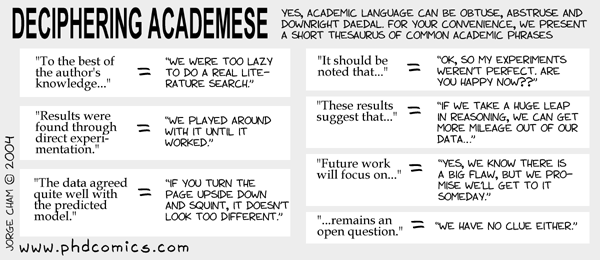
Academese-A new language

As a person who has straddled the academic world and the 'real' world of journalistic and business writing, I've gained some perspective on so-called 'academese'. Any reader with a liberal arts background like mine knows exactly what I'm talking about. We're talking essays with monstrous titles like 'Postdialectic narrative and neodialectic submaterial situationism in post-Heideggerian hermeneutic analysis' and other such tripe. We've all read this stuff, or, should I say, we've all tried to digest as much of it as possible before frisbeeing it across the room and then turning our attention to skateboarding dog videos on YouTube.

Granted, if you've been a liberal arts student - and especially if you've done graduate studies in the arts and humanities - you've almost certainly been required to write something like this at one time or another. It's sort of a rite of passage. I for one have suffered through having to write papers on various aspects of postmodern philosophy that involved using impossibly opaque language. I remember once having to write an analysis of the trial of former East German leader Egon Krenz from the standpoint of Jacques Derrida's postmodernist theory. I even got a good mark on it, which is amazing given that most of Derrida's writings might as well have, from my standpoint, been written in Lithuanian.

This is just academic bootcamp, part of basic training. However, what I do find troubling is when this type of scholar-babble become a modus operandi among academics and is used where it's not only unnecessary but also a barrier to comprehension. A big part of what drew me to the field of history was its proximity to storytelling, wherein clear, polished prose that people actually enjoyed reading seemed to be valued. And yet even here I had colleagues writing papers with titles like 'Microhistoricity: a meta-discursive treatise on hyperreality tropes in post-metahistoriographical analyses' and whatnot. Yup, can't wait to get my hands on that one!

So why do people persist in writing crap like that? To my mind, there are three main reasons for it:

1) Insularity of academic culture - They don't call it the 'Ivory Tower' for nothing. Granted, there are a great many people across all academic disciplines who are very much involved in the outside world and do write with the general public in mind. However, academic culture does tend to be insular and insular cultures have a way of breeding their own dialects that are indecipherable to outsiders. In fairness to academics, the business world is no different, a phenomenon to which the numerous online corporate bullshit generators attest.

2) Academic grandstanding - Gratuitous academese is the ivory tower equivalent of those cheesy guitar-behind-the-head-and-tongue-distended heavy metal guitar solos. It's academic penis-envy, pure and simple. A former historian colleague of mine who was also a gear-head once compared impenetrable academese to muscle car enthusiasts looking for ever-more grandiose modifications for their cars. I personally think a better metaphor is extreme body-modification, sort of a "Let's see how much I can torture the English language before it all unravels" approach to writing.

3) Lack of writing instruction in graduate schools - This, in my humble opinion, is the all-important culprit. I was lucky that when I was a grad student I had one prof in particular who really put us through Navy Seal writing training. That and I also wrote prolifically for student newspapers and whatnot, which probably did more for my craft than any class I ever took. But for a great many grad students, there simply isn't that opportunity - or that emphasis. As a result, students lacking confidence in the written word resort to academic gobbledygook not so much as a means of grandstanding but as a sort of security blanket. And then they get pats for it, which compounds the problem.

To sum up, I think there needs to be a whole lot more emphasis placed on the writing craft at all levels of school - and at the graduate school level in particular. My current scholarly abode (the part-time PR department at Grant MacEwan University) has a mandatory 'Writing Fundamentals' class followed by 'Writing for PR'. I think any scholarly field striving for comprehension beyond its own narrow confines - be it engineering or linguistics - ought to have the same requirement.

In the meantime, here's a Postmodern Essay Generator for your amusement.