Yesterday I came across an article in the Toronto Sun that made my blood boil. The article, which was entitled '10 Ways Not To Be Poor', began with the opening salvo "The perpetually poor are not blameless." (Right off the bat you know where this train is going.) Sun columnist and 'conservative radio personality' Jerry Agar then proceeds to offer ten pearls of wisdom as to how to avoid being chronically destitute, such as don't see life is a lottery, don't set low goals and learn how to "manage your emotions." Thanks Mr. Spock. That's really useful!
Of course, Mr. Agar makes no mention of extenuating factors such as mental illness, physical ailments, domestic violence, inadequate public transportation, public safety concerns (in many cities) and other problems that contribute to trapping people in poverty. Nor does he acknowledge the importance of community organizations, educational programs and cultural institutions (all of which depend on government support for their existence) in helping people break free of the poverty trap. Moreover, he derides "pop culture and self-help programs" for instilling a culture of "wishing and hoping" while simultaneously spewing out a parade of platitudes taken straight from a third-rate self help book. Sometimes the irony truly writes itself.
What really gets me about this article, though, is what its actual intended purpose is. Imagine, for a moment, that you are a poverty-stricken person with two jobs, three kids to feed, a Mount Kilimanjaro-sized pile of bills on the kitchen table, disconnected power and an impacted molar that you can't afford to get fixed. You pick up the Sun at your bus stop at 11:00 pm on your way home and you read Jerry Agar's column, which its sage advice such as "God helps those who help themselves" and "Some low-income people find a way to save for the future, but they do so by foregoing $300 Nike shoes." Is there a single low-income person thus far who has read that article and thought to themselves, "Wow, I hadn't thought of that! I see the error in my ways!" I doubt even Jerry Agar can imagine such an occurrence.
Why, then, did he choose to inflict this article on the public? On this blog I make a conscious effort to write things that are either a) entertaining, b) enlightening, or c) a bit of both. Agar's column is none of the above, which to my mind leaves only two options. One - he could be deliberately trying to piss off his readers for pure shock value. Two - he's engaging in classic right-wing journalistic masturbation aimed at readers who enjoy nothing more than stewing in their own smug sense of superiority over those 'silly' poor people are 'silly', while simultaneously giving them an outlet for their righteous indignation over tax dollars going to social programs designed to help people who don't ever 'help themselves'. The first I can respect, although he's a far cry from a Christopher Hitchens in the wit department. The second I just can't get behind.
With that in mind, here is a Top Ten of my own dedicated to Jerry Agar and others like him. Call it 10 Ways Not To Be An Asshole Columnist, or something like that.
1) Ask yourself what the point of your article is. And unless it actually enlightens, entertains or shocks (in an entertaining or clever manner), think perhaps about writing something else.
2) Back up your facts when you make accusations. For example, if you're going to accuse poor people of mismanaging their finances (or buying athletic footwear that they can't afford), have at least some anecdotal evidence.
3) Try not to make the same point again and again while pretending they're different points. For example, "believing in the quick fix," "believing life itself is a lottery" and "believing in wishing and hoping" are, if I'm not mistaken, the same point worded in three different ways. That's annoying, and not to mention a transparently cheap way of padding your points to reach the number ten.
4) Don't make crass assumptions about people you don't know. When you say things like "Stay off illegal drugs and off alcohol if it causes problems in your life" you're essentially insinuating that everyone who is poor is an addict, which results in deepening existing stigmas against marginalized groups, thereby lessening people's likelihood of breaking out of poverty. (OK, this is kind of the same point as number two, but so important that I think it's worth mentioning twice.)
5) Don't insult your reader by stating the obvious. When you spout crap like "Drunks are bad at self-analysis," not only do you sound like an idiot but you're most likely to alienate your readership - unless your reader is of exactly the same mind as yourself, in which case they have no need for this article.
6) Don't foist advice on people that isn't really advice. If, for example, you say "Don’t have children until you are able to financially care for them" and your reader is an 18-year-old single mom struggling to get by, what do you expect her to do? Un-birth her child? Oh, and accusing her of being a 'child abuser' doesn't help.
7) If you're going to invoke scripture, do it properly. As my old pal Tyler Gingrich (aka The Political Pastor) pointed out to me, the line "God helps those who help themselves" is nowhere to be found in the Bible. In fact, many if not most Christians consider these words to be contrary to the Biblical message of God's grace. If nothing else, it's a tired cliche that doesn't really mean anything but is so prevalent that most people assume it's in the Good Book. It isn't.
8) If you're going to criticize government policy, offer some potential alternatives. As opposed to simply saying "We’ve spent billions on a “war on poverty” to negligible effect as there are still huge numbers of poor people" and "Perhaps we should demand more from people who stay on public support for decades and for successive generations," it would perhaps be more beneficial to offer some alternative strategies. To not do so suggests that you have no more idea than anyone else what to do to resolve the problem of inequality in our society.
9) Offering links to useful sources would be nice. The great thing about the Internet is that you can create links to other useful sources of information. And when it comes to a hugely consequential issue like poverty, you would think that the author would provide some 'further information'. Nobody's asking you to be an expert on everything. But it would be nice if you'd give credit to people who know more than you do on the subject, and have more to offer readers who are struggling to improve their lot in life.
10) Please stop repeating the line "It is not too much to ask." That's just annoying.
I should probably qualify all this by saying that I don't disagree with the assertion that individual bad decisions are a factor that contributes to the cycle of poverty. Nor am I some loony leftist whose response to everything is throwing more money at the problem. In fact, I do believe that we are a culture with a huge sense of entitlement much of the time, a characteristic that both the ideological left and the ideological right display in abundance - albeit of a different plumage. The ideological left expects government to coddle society. The ideological right gets incensed when asked to fork out for anything that doesn't directly apply to the individual taxpayer's narrow set of circumstances, such as alleviating poverty, solving the climate crisis or keeping ballet companies from going bankrupt.
Poverty is a colossally complex problem with innumerable factors, some of which are derived by personal behaviour and others that are tied to institutionalized inequality of one sort or another. My fundamental problem with the article in question is that it insinuates that all of us are born into this world with equal opportunities and that 'privilege' - be it of the racial, gender or socioeconomic variety - does not exist. I most strongly disagree and I would love to hear Jerry Agar's argument to the contrary.
Incidentally, your comments - bouquets and brickbats alike - are more than welcome. And Jerry, if you're reading this, I invite you with open arms to respond. And please be nice. It's not too much to ask.
Wednesday, 25 July 2012
Monday, 9 July 2012
7 Countries Whose Names Are Wrong

As the country once (and largely still) known as 'Burma' has made its initial tentative steps toward democracy following half a century of harsh military rule, an interesting conflict has emerged between the still-ruling generals and opposition leader Aung San Suu Kyi. The Burmese pro-democracy leader and Nobel Peace Prize winner has up to now stubbornly refused to refer to her home country as 'Myanmar' in spite of the country's official name change in the late 1980s. Now, with Suu Kyi's party negotiating its way into the country's political mainstream, the geriatric generals still in charge have issued a stern warning against referring to the country as 'Burma'.
![]() |
| "When I'm elected president, I'm changing this country's name to an incomprehensible symbol. That should shut them up!" |
Suu Kyi, by contrast, asserts that the name 'Myanmar' is a product of the massive government crackdown in 1988 and points out that the name change was imposed on the country without the slightest input from the Burmese people. (A whole host of names were changed during the same period - Rangoon to 'Yangon', Pagan to 'Bagan' and so on.)
So who's right in this debate? In a sense, both sides are. Burma/Myanmar (or 'The Country', as Hillary Clinton diplomatically called it on her recent trip there) is a diverse multiethnic society of which the Burmans are but one (albeit predominant) cultural and linguistic group. Suu Kyi further asserts that the government's name-changing campaign also saw a vast number of communities in non-Burman regions changed in ways that rendered them nonsensical in the Shan, Karen, Rohingya and other minority languages. In that sense, neither Burma nor Myanmar is cut out for the job.
But is this a big deal? After all, many countries have names that, when you really dig deep, don't make that much sense. Countries have been named for all sorts of bizarre reasons. Both Japan and Vietnam get their names from their geographical relationship to China. Nippon (日本) means 'Sun-Source' in reference to its easterly position to China, whereas Việt Nam is an inversion of 'Nam Việt' (南越), which refers to its southerly position vis-a-vis the ancient Chinese province of 'Yueh' - the antecedent to present-day Guangdong province.
Further west, the country known as 'Russia' gets its name from the 'Kievan Rus', which was located in present-day Ukraine, as does 'Belarus', while the name 'Ukraine' itself merely means 'borderland'. And then there's 'France', whose name means 'Land of the Franks', a Germanic tribe whose empire centred primarily on present-day Westphalia in Germany. Indeed, it seems that many of the world's most brazenly patriotic countries are named after other places.
Some country's names, however, are flat-out incorrect. However, in none of these cases has there been any move to change said names. For better or for worse, people have come to like their incorrect nomenclature - and in some cases the bizarreness of their names has become a matter of tongue-in-cheek national pride.
1) Canada
Canadians all know this story - at least we all learned it in junior high. 16th century French explorer Jacques Cartier and his scurvy-stricken crew were directed southward along the St. Lawrence River to what the locals referred to as Kanata. The settlement in question was in fact called Stadacona (located where Québec City now stands), what with kanata simply being an Iroquoian word for 'village', but the misunderstanding quickly stuck - and survives to this day.
2) Peru

At least with Canada it was an easy-to-fathom misunderstanding. The naming of the present-day Republic of Peru, on the other hand, was an act of geographical (and cultural) laziness to say the least. The name 'Peru' derives from a mispronunciation of Birú, a chief who ruled over a region near the Bay of San Miguel, Panama, in the early 16th century. For whatever reason, the Spanish conquistadors leapt to the assumption that the guy ruled everything south of what was then known to them, oblivious to the proud denizens of the Inca Empire and their imprint on the place. It certainly wasn't an auspicious start to this relationship.
3) Senegal
The prevailing explanation of the etymology of this west African nation is rather similar to that of Canada. The story goes that the name derived from a miscommunication between local fishermen and the Portuguese explorers who arrived there in the 15th century, who interpreted the Wolof phrase sunu gaal, meaning 'our canoe', as the name of the river - and by proxy the country. While this explanation remains contested, the canoe story has embedded itself into Senegalese cultural lore and is often invoked in calls for national solidarity along the lines of "We're all in the same canoe."4) Madagascar
Thanks to the DreamWorks film by the same name, many young North Americans are probably oblivious to the fact that Madagascar is an actual country. And of those who are aware of its actual existence off the coast of southeastern Africa, very few probably know that the name is not of local origin but was in fact conferred on it by the 13th century Venetian explorer Marco Polo, who mistook the place for Mogadishu. Granted, this was a more flattering comparison in the 13th century, when Mogadishu was a grant cultural and economic capital of East Africa, but it still a remarkably egregious mistake.5) Singapore
The modern city state of Singapore was first founded in the 14th century by a Tamil prince named Sang Nila Utama as part of the Srivijayan Empire. The name itself, an Anglization of the Sanskrit Singapura (सिंहपुर) - which means 'Lion City', derives from the prince's alleged spotting of a lion on the shores of where Singapore now stands. While the lion has since become an emblem of the place, unless it escaped from a local zoo it was almost certainly a tiger, as lions have never been an indigenous species to the region.6) India
The name 'India' derives from the Indus River, which together with the Ganges and the Brahmaputra form the crucible of South Asian civilization. While not incorrect at its origins, the Indus, since 1947, has flowed in its entirety in Pakistan. Interestingly, Pakistan's name is also somewhat suspect - not so much incorrect as a product of wishful thinking, the product of an acronym of Punjab-Afghania-Kashmir-Sindh-Baluchistan. A reaching acronym to say the least, and not wholly accurate given the still disputed nature of Kashmir.7) Greenland
In a perverse turn of fate, man-made global warming may yet prove Erik Thorvaldsson to be a prophet of sorts. Nevertheless, this now autonomous country within the Kingdom of Denmark is probably the only country whose name was an act of fraud. The murderous 10th century Viking better known as Erik the Red who was exiled from his native Iceland for "some killings" had a great deal invested in attracting settlers to his western discovery, and figured that the name Grønland would do just that. While his ploy may have worked, the early Norse settlement in Greenland never got off to a good start and failed spectacularly in the end. Perhaps a more honest name would have helped.
Thursday, 28 June 2012
8 Reasons Why People Love Numbered Blog Posts

There's something about Top 10 Lists or Top Insert-Your-Own-Number Lists that seem to never fail to captivate. We all love lists, and from David Letterman's Top Tens to the never-ending music-related top tens in the famous 2000 music-geek dramatic comedy High Fidelity, Top-Whatever lists seem to be hardwired into our DNA.
In the blogging world, numbered posts are known as 'link bait' as they seem to unerringly draw traffic. It has become a universal format across the blogosphere, employed by blogs ranging from Foreign Policy Magazine online to Cracked.com. Unlike Letterman and John Cusack's melancholy vinyl peddler, numbered blogs more often than not don't stick to the Top Ten format (to me ten seems a bit contrived and inherently less credible), but any number in the Top X format seems to do the trick just fine. In my own experience, these posts always draw the most traffic.
Why is this? Here is my own highly speculative and unscientific explanation.
1) People like small tidbits of information.
The average netizen has the attention span of a goldfish. Moreover, as people read twice as slow on a screen as they do on a printed page, this small chunk-like paragraph format works very well. Dive into the page, gobble up a few tidbits, and then head off somewhere else - that's how the Internet rolls.
2) People don't like to commit to reading an entire article.
Did I mention that people on the Internet are decidedly lacking in attention span? Reading an article with a daunting title like 'After The Wave - The Communications Lessons of 3.11' seems like a tall order after a long day at the office, and with an essayistic piece like that you feel committed to reading it in its entirety. With a list, you feel free to read a few and then leave - or keep reading if you're feeling sufficiently intrigued.
3) Lists are inherently suspenseful.
While the opt-out option of a Top-Whatever list is a definitely psychological draw, human beings tend to want to know how things end. If it's a well-written list, chances are your reader is in fact going to stick around to the end - unless they have to run off somewhere.
4) The list format is hardwired into our culture.
Thanks to Letterman, Cracked, High Fidelity and pop culture in general, lists are an integral part of how we interpret the world. And this is not new - this format dates back at least as far as Moses, who really owned the Top Ten format like nobody else in history, and the US Constitution, which modernized the format in the Enlightenment era.
5) It's appealingly irreverent.
Taking a serious topic and distilling it through the Top-Whatever format is appealingly disarming. Former Discovery magazine editor Stephen Petranek exemplifies this in his 2002 TED talk on 'the 10 most likely ways that life on the Earth could end'. It's a disarming way of tackling a serious topic that grabs your attention - and then holds on to it.
6) It's a natural lightning rod for debate.
If it's an interesting topic, people are bound to have their own opinions on what should be on said list, and people are going to want to compare and contrast with their own Top-Whatever. And people love to fill you in on all your egregious omissions.
7) It's a friendly and approachable format.
We all make lists. We've been making lists since the dawn of time. And blog posts in the form of a list feel real, genuine, not-at-all haughty. Had Fyodor Dostoyevsky rewritten Crime and Punishment as 'Top 20 Occasions When Cold-Blooded Murder Is Probably Beneficial to Society', he invariably would have had a far greater readership.
8) I guess people just like to count.
And we can all thank own favourite arithmomaniacal ex-pat Transylvanian muppet for that.
Thursday, 21 June 2012
Yahwehpedia - The Bible as Precursor to Wikipedia
One of my most memorable undergrad courses was an introductory Old
Testament/Hebrew Bible course I took as an extra credit course. The
instructor - who introduced himself as a 'recovered fundamentalist' -
introduced the topic thusly. He entered the classroom with a tape
recorder, placed it on his desk and asked for a show of hands from the
students assembled.
"How many of you believe in the Bible literally?" he asked. There was a peppering of hands. He then responded, "Okay, here it is." He pressed play and on came Genesis, Chapter One, Verse One - in the original Ancient Hebrew. He let it play for approximately 30 seconds and then paused the tape. "How many of you understood that?" he inquired. Not surprisingly nobody raised their hand. "Well, in that case I guess you can't take the Bible literally. And that's why you're in my class."
For those reading this post who do not adhere to literalist views of the Old and New Testament (and I'm guessing that's most of you), your response to this anecdote is probably one of "Duh, no kidding!" But it does beg the question of how one is supposed to grapple with what is indisputably the single most influential written work in the history of humanity. If not as literal truth, which it could not possibly be, how is one to approach the Bible? As a heavily sensationalized and politically biased history tome? As a work of historical fiction centred on a capricious, volatile-tempered supreme being? A chaotic amalgam of texts assembled by committee? None of these approaches seems quite satisfying.
A better analogy for the Bible, in my opinion, is the modern-day Wiki. In my previous post on children's fable, I refer to Jonathan Salem Baskin's wonderful book Histories of Social Media: 2,000 Years of Do's and Don'ts, in which he likens Wikis to premodern oral narratives, created by way of layer upon layer of input on the part of the storyteller. I would further argue that the Wiki concept applies perfectly to the creation of the Bible. This is particularly true of the oldest books in the Old Testament, which comprise the Jewish Torah, which are comprised of four distinct narrative layers - the Yahwist, the Elohist, the Deutoronomist and the Priestly strands - which together span three centuries of user contribution.
The Bible is of course not alone in this format. Most if not all major religious doctrines were created in this manner, through a layering of narratives over the course of centuries. But the Bible, as a result of its size and magnitude, must be considered the mother of all premodern Wikis - and therefore the Wikipedia of the ancient world. Consider that the Old and New Testament were created by multiple authors for the purpose of creating a one-stop compendium of everything these authors knew and believed to be true at that time. It covers a vast swath of topic areas, from law and order to farming techniques to poetry to pure adventure stories, centred of course on the primary focal point of the civilization in question - belief in Yahweh.
The New Testament retains the same format, focusing instead on one very big topic - the persona of Jesus of Nazareth. By this point, you basically only have four contributors left, although each may have been a committee of writers and editors under a single name. But still, there seems to be no shortage of competing views? Was Jesus actually the Son of God, as the Gospel of John clearly states, or is the Son of Man - whatever that means - a more accurate characterization, as the Gospel of Mark states. Was he the stern lawgiver as portrayed by Matthew or the gentle healer of Luke - or a combination of both? Unfortunately we have no real way of knowing because, unlike with Wikipedia, Christ's disciples weren't required to provide footnotes.
And then it all came to an end. Fearing that disputes within the new Christian faith would undermine the stability of the Roman Empire, the Christianized Roman Emperor Constantine summoned the Council of Nicea in 325 C.E. for the purpose of nailing down the Biblical canon once and for all. A decision was finally reached in 397 in Carthage, a full sixty years after Constantine's death. This brought to an end the open-source nature of the Bible in what would be the modern-day equivalent of shutting down Wikipedia from any further constribution and treating it as an online authority not to be tampered with.
Of course not everybody went along with this, and four centuries later Yahwehpedia 2.0 (also known as the Qur'an) was launched. While the Qur'an itself was not open-source, the innumerable Hadiths and other religious texts followed that very same Wiki-type format for several centuries thereafter and in a different form persists to this day in the form of the various fatwas issued by Islamic scholars throughout the Muslim world.
What does this mean? The Wikipedia model is, to my mind, a useful lens for examining the world's most important and controversial tome. Written over the course of centuries by a plethora of authors, each with their own particular slant but all striving for what they perceived to be accurate, the Bible is exactly what an ancient Middle Eastern version of Wikipedia would have looked like, grounded in contemporary understandings of how the world worked. Yes, much of it seems ridiculous to 21st century secular readers, but then again much of our present-day Wikipedia content will invariably look hopelessly ill-informed two millenia from now - should our species still be around at that time.
As for whether any or all of it was 'divinely inspired', I'll leave that hornet's nest alone. I will say, though, that if I were of a more religious disposition, I would be the first to champion the creation of a true open-source, democratic holy book for the 21st century built along the lines of Wikipedia. In sum, a true non-prophet organization.
Wednesday, 13 June 2012
8 Digital Media Rules As Told By Children's Fables
Social media - is it a truly revolutionary development that is reshaping our world in a radically new fashion, or is it simply a digital recasting of ancient social patterns?
The book analyzes the forms and functions of social media one by one and in all cases finds historical antecedents. Crowdsourcing? The author alleges that villagers in medieval Europe used it to learn about treatments for the Black Plague. Engagement? 19th century industrial unions planned activism in ways that make 'friending' a product or service little more than a joke. Conversation? The Roman Senate used it to run an empire while the perpetrators of the French Terror used it to commit mass murder. Debate? People have jousted and dueled for centuries. Wikis? Oral narratives were the product of waves of user contributions, as was, for that matter, the Old Testament.
In today's world, many parents and teachers worry about letting their children loose in the dangerous digital jungle of the information age, with all of its many monsters and menaces. How did their counterparts in the ancient and medieval world safeguard their kids? Thanks to Aesop, the Brothers Grimm, Hans Christian Andersen and other social media educators of yesteryear, there has long existed an enormous body of cautionary tales about how to navigate this often dangerous terrain. And as it turns out, many of these fables apply just as well to today's social media as they did to the social and cultural landscapes that gave birth to them.
1. The Town Musicians of Bremen
Lesson: State your mission and objectives clearly when launching an online campaign.
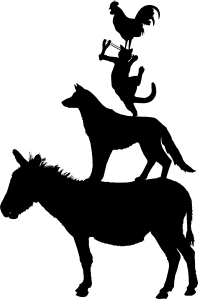
The Brothers Grimm's famous folktale about four disgruntled barnyard animals who abandon their abusive keepers and set off for the town of Bremen to become town musicians is a powerful tale of emancipation from mistreatment as well as a polemic against ageism (all four are 'past their prime' in terms of their usefulness). But it's also a lesson in the power of a clearly stated goal and purpose. Had the donkey simply said, "Hey guys, we're gonna hang out, maybe play some tunes and stuff..." it's unlikely that the four beasties would have banded together so closely. As it happened, they never ended up going to Bremen but the power of their strategic plan was enough to see them through every obstacle in their path.2. The Ugly Duckling
Lesson: Don't stick with an online tool that doesn't fit your organization.Most if not all digital media afficionados can relate to Hans Christian Andersen's melancholy cygnet who is ostracized by his adopted duck siblings before eventually finding a welcoming community of fellow swans. Most of us were nerds and misfits of one sort or another. But the tale of the Ugly Duckling is also a lesson in compatibility and the futility of sticking with tools that don't work. Just because people or organizations closely associated with you are using a certain type of digital tool doesn't mean it will necessarily work for you. Analyze your communications needs, scout out all the available tools and choose the best match.
3. The Boy Who Cried Wolf
Lesson: Transmitting excessive irrelevant information undermines your status as a credible source.
Regrettably, social media networks are full of people who behave like the irresponsible shepherd boy in Aesop's famous tale about the perils of dishonesty. However, one doesn't even mean to be flat-out mendacious in order to suffer the same fate as the shepherd boy in today's social media world. The Boy Who Cried Wolf serves as an allegory for online reputation management, in which steady bombardment of useless information transmitted for its own sake means that genuine calls to action go unheeded. Decide what is - and isn't - worth communicating based on whether or not it meshes with your mission and stick with it.4. The Tortoise and the Hare
Lesson: Slow and steady communication trumps sudden bursts of activity.
The story of the greatest athletic upset in all of fiction serves as a powerful allegory for social media - and for Twitter in particular. In the Twittersphere, the only way to establish yourself as an influencer is through slow and steady daily output. Short, fleeting bursts of output followed by lengthy absences will completely undermine your effectiveness. The same also applies to blogging, where short but regular posts will galvanize your status while impressive flurries of activity followed by silence will get you nowhere in the blogosphere5. Little Red Riding Hood

Lesson: Take every measure to protect your online privacy.
This one is really a no-brainer. The character of the wolf in Charles Perrault's iconic fairy tale can be used to represent any number of online villains: hackers, identity thieves, Trojans, online predators....you name it. Having successfully gained access to Grandma's IP address, password information and various other choice bits of information, the wolf successfully commandeers her entire system and had it not been for the Deus ex machina intervention of the woodcutter-cum-IT troubleshooter, all would have been lost. At least Grandma thought to back up her system.
6. The Three Little Pigs
Lesson: Spend the money and build it properly from the beginning.
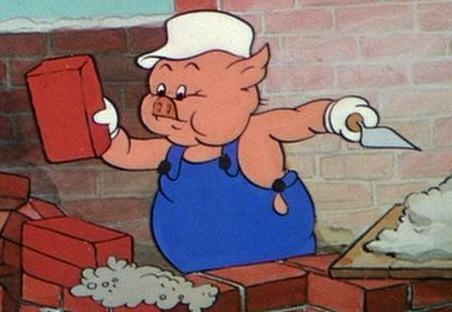
Three little companies set out on their own to build their own websites and establish solid online presences. In this case, the 'wolf' isn't a single identifiable menace but rather the cumulative effect of social and economic shifts, changing demands, the forces of competition and adversity as a whole. The third little pig invested in a first-rate website with a flexible content management system, a stable and user-friendly CRM and an intranet so as to facilitate good internal communication. The other two companies threw together something cheaper and faster - and suffered the huffing and puffing of a volatile marketplace and changing demands.7. The Emperor's New Clothes
Lesson: Make sure you consult internally before embarking on a new tech development.
Here's a fable we've all heard before. A CEO decides it's high time to embark on a stunning new digital media campaign. He hires a team of slick IT consultants who entrance him with various exotic-sounding tools, and poof - he's sold. Unfortunately, he fails to consult with his staff, his business partners and other stakeholders and winds up with a website or array of digital tools that end up being completely ill-suited for the company's activities, while the consultants walk away with a fat cheque. In the end it's a bratty intern who opines that the new system frankly sucks ass. Moral? Get a second, third, fourth opinion before you drink the Kool Aid.8. The Shoemaker and the Elves
Lesson: Take advantage of your people and let your online community do the work.
There's something very refreshing about the Brothers Grimm's tale of the destitute shoemaker whose fortunes are dramatically reversed thanks to an enterprising team of diminutive cobblers. While a great many children's fables champion grunt work and thankless industriousness, the tale of the shoemaker and the elves tells a very different lesson - take full advantage of the help that's offered, whatever shape it may take. And nowhere is this lesson more applicable than in today's social media, where the only route to success is creating conditions where your stakeholders take over the means of communication and communicate your messages for you. Give your people the materials (information and key messages) and let them do their thing while you monitor it. And you will reap the rewards.Got any other examples of children's fables that are allegorical to today's social media? I'd love to hear them.
Saturday, 9 June 2012
Tyrants, Terrorists and the PR Firms Who Love Them

In previous posts, I've alluded to the PR profession's very own PR problem. Public relations professionals are more often than not portrayed in films and on TV as gleefully amoral reprobates along the lines of Nick Naylor in the 2005 black comedy Thank You For Smoking and Washington 'spin doctor' Stanley Motss, played so memorably by Robert De Niro in the 1997 film Wag The Dog. Either that or they're portrayed as self-centred opportunists like Eli Gold in The Good Wife or Samantha Jones in Sex and the City or as tortured would-be altruists like fictional White House Communications Director Tony Ziegler in The West Wing.
Why the bad reputation? As with most bad reputations, it's a relatively small group of individuals who end up painting their entire community in a negative light. In the case of public relations, there indeed are practitioners who advocate on behalf of less-than-salubrious causes. And in the most extreme cases, there are indeed well-heeled PR firms in the UK, the US and elsewhere whose client lists have included the world's most appalling human rights abusers.
![]() |
| The dream PR client? |
While Bahraini forces were imprisoning and torturing protestors, these firms helped the regime denounce its most prominent critics as extremists and fifth-columnists for the Iranian regime through ominously titled divisions like Qorvis' Geo-Political Solutions branch. This campaign included fake tweeting, fake blogging (known as 'flogging') and other forms of online manipulation aimed squarely at activists like Maryam al-Khawaja, the current acting head of the Bahrain Center for Human Rights who continues to receive death threats while her father remains in captivity following the revolt.
Regrettably, the Bahrain case is far from unusual. The Monitor Group, a British PR firm with 29 worldwide offices, ran a PR campaign on behalf of the Qaddafi regime in Libya between 2006 and 2008 to the tune of about $3 million. In addition to helping prop up the Bahraini dictatorship, Qorvis was also for a time being paid some $60,000 a month by the repressive and obscenely corrupt regime of Teodoro Obiang in Equatorial Guinea, while its colleagues at the Washington Group were in the pay of now deposed Tunisian dictator Zine El Abidine Ben Ali.
Of course, the relationship between PR firms and despotic regimes is nothing new. American PR pioneer Ivy Ledbetter Lee, considered by many as the father of modern public relations, is today largely remembered for his relations with the Nazi regime through the controversial German chemical industry conglomerate IG Farben. Meanwhile, his one-time rival Edward Bernays - also considered by many as the 'father of PR' - helped engineer the overthrow of the democratically elected government of Guatemala in 1954 on behalf of his blue-chip client United Fruit.
All this begs the question: are there any cases in which taking on a dictatorial regime as a PR client is morally fathomable? David Wynne Morgan, the chairman and CEO of Pelham Bell Pottinger (one of the firms linked to the Bahraini regime), argues that there are good reasons to take such clients on. In an RT interview, Morgan alleges that "A country frequently will modify its actions and its policies in order to achieve perhaps what is the greater ambition of having better relations with the people they're seeking to influence, so it's a balance." All fine and good in theory, David, but I have yet to see any compelling evidence of this, least of all in Manama.
It goes without saying, of course, that the vast majority of people in the PR profession will never have anything directly to do with propping up dictatorships, terrorist organizations or other clients with prodigious body counts. But even the best-intentioned communications professionals can find themselves in thorny ethical territory. In my previous capacity as a copy editor and translator for a Tokyo translation company, I was on more than once obliged to do work for Japan's largest cigarette manufacturer, Japan Tobacco. Should I have refused to do it? Perhaps I should have, but at the time I feared it would have jeopardized my job if I did, so I did what I was asked to do.
I like to think of myself as a morally and ethically principled human being. And as a public relations practitioner, I like to think I know where my line is as regards ethically indefensible work. As much as I enjoyed Thank You For Smoking, I would never, for example, knowingly and willingly go to work for the tobacco industry. Nor would I do the same for any other industries I personally find objectionable, such as firearms, genetically modified foods or the diet industry. I have mixed feelings about oil and gas (and not just because I live in Alberta). It's a problematic industry but a necessary one, and certain companies are far more laudable in their practices than others.
While I indeed find it horrifying that there are PR professionals like me out there working to burnish the reputations of the world's most vicious and corrupt regimes, I stop short of condemning individuals within said firms. I have yet to meet anybody in the profession who is motivated solely by money and a desire of edgy and exciting clients along the lines of Muammar Qaddafi, but it's easy to see how a person in the field could end up in a situation with a firm where it would be very difficult to extricate themselves from such a situation. Establishing a firm ethical stance early, finding employers whose values align with your own and remaining alert to ethically compromising situations is probably the only answer.
Meanwhile, I will continue to savour in the guilty pleasure of movies and TV shows about nefarious, morally pliant PR people. Because they're fun.
Thursday, 7 June 2012
7 Tips For Writing Destination Articles On Places You've Never Visited
I used to do a lot of travel writing. When I lived in Tokyo, I had an assortment of semi-regular clients for whom I would write 'destination pieces' pertaining to Japan. While I don't get many of these at present (Edmonton isn't quite the blue-chip destination that Tokyo is), I do get the occasional one from old clients. This week I was approached by the editor of SilverKris, Singapore Airlines' in-flight magazine, about an article on Toronto. I, of course, don't live in Toronto and actually haven't really spent that much time there, but given my prior relationship with the magazine, my passing familiarity with Canada's 'Centre of the Universe' and the fact that I have numerous friends and colleagues there, I took the job on.
While I am somewhat familiar with Toronto, having visited the city several times, there have been instances - and this is my dirty little secret as a writer - where I've written articles on places I've never actually been to. Is this dishonest? I don't really think so. After all, I've never misrepresented my own travel experience to get a gig and in cases like this I've been upfront that I a) haven't been to the location the editor wants the scoop on, and b) won't be able to unless they pay me a enough that I am able to take the time off work, go to said location, write about it and still make money on the whole deal. That hasn't happened yet. Perhaps I'm writing for the wrong people.
While there are no doubt editors out there who would choke on my commentary here (and I'm hoping I don't lose clients by writing this), my stance is that there is nothing wrong with writing travel pieces on destinations that you personally have never visited as long as you're honest about it and you really do your research. Having said that, you do have to be careful, and there have certainly been cases in the past where I've decided that I was in no way qualified to write a particular destination piece and have turned the offer down. When it comes to making a decision on whether to take on an assignment I have my own personal guidelines. Here are my seven rules. I would be interested in hear what any other writers have to say on the subject.
![]() |
| Nope, haven't been here. |
There's only been one case where I've written a destination piece on a country I'd never visited. It was an article written for Air New Zealand for Tokyo Weekender where I was asked to profile the city of Auckland. I've never been to New Zealand and I was upfront about it, but for whatever reason they still wanted me to do it. But apart from this one case, I've only ever written about destinations I've never visited when I was already very familiar with the country and region in question and could draw at least somewhat on my own experience. You could probably write about Jasper National Park without going there if you've been to Banff or Waterton and have a grasp of Canada's Rocky Mountain Parks in general. Writing about Jammu and Kashmir without having been anywhere in northern India - that's a different story.
2) Talk to at least two different people who know it well.
This also applies to writing about a place you kind of know but haven't spent a great deal of time in. Get a second opinion. And especially if you've never been there, get a second and a third opinion, lest you be stuck with a singular viewpoint that you can't actually back up. My advice would be to find two people of different backgrounds who know a place - perhaps one native-born resident and one ex-pat. Possibly both a male and female view of the place. Get creative. If you don't know anyone from somewhere, call a local travel bureau and find someone to talk to.
3) Do your homework.
It goes without saying that you need to do your research for any travel destination piece, even one that you know intimately. Ownerships change, restaurants go out of business, people change phone numbers, new train and bus services are added - you need to stay current. This applies all the more when you're writing about a place you don't know very well - or don't know at all. Get to know the history of the place. Get to know its character. Familiarize yourself with every facet of the place that you can - everything short of physically going there. And wherever possible, immerse yourself in photographs of the place, which will help you flesh your writing out with physical description of things.
4) Use quotes from famous locals, noted authors etc.
Don't have any personal anecdotes about a place? Use other people's. I once wrote an article about famous ryokans (traditional inns) in Japan and wasn't able to get to all of them in person, but it proved to be not too difficult to dig into their histories and find out what famous people had visited them, and what certain poets of yesteryear had written about the surrounding region. Fill your writing with as much local colour as you can and say something like, "Don't take my word for it; the poet Basho thought this place was the BOMB!"
5) Profile things that don't required first-hand, on-site knowledge.
![]() |
| Haven't been here either. |
And if there aren't any special events or anything noteworthy going on, it's worth asking yourself if this particular destination is worth covering at all.
6) Check your facts after you're done.
Again, this really should go without saying. By this point, you should have established good working relations with your field sources. Run your draft by them and make sure what you're saying makes sense and actually applies. And again, if possible, get a second and possibly a third opinion.
7) If at all possible, do actually go there - even if only for a couple of hours.
To be fair, this is often impossible, but when I lived in Tokyo it was sometimes feasible to make a very quick trip someplace, get off the train, have a quick look around, find two or three interesting and/or quirky things to write about, grab a handful of brochures and go straight back to the big smoke. There were times where I didn't even leave the vicinity of the main railway station and was still able to get a quick sense of the vibe of a place - before grabbing a few brochures, talking to a few people in the local tourist office and then leaving. That's not going to be possible everywhere (namely in Canada), but wherever possible you should find a way to actually go somewhere, even if it's for a split-second in travel terms. If nothing else, it'll make the assignment easier.
For your reading pleasure, here's the article I wrote on Japan's historic ryokan back in the summer of 2008. Hint: of the six inns profiled in the article, I was only actually able to visit three of them. I would be curious to know if you can guess which ones they were.
Subscribe to:
Posts (Atom)