Showing posts with label Airline Industry. Show all posts

Friday, 21 February 2014

EIA New Destination Showdown - Dallas vs Reykjavik!

 
After many months of anticipation, Edmonton International Airport will finally inaugurate the city's most highly anticipated new air route in ages, Icelandair's Edmonton-Reykjavik non-stop. While our marketing and communications team here at EIA expected excitement around this new connection, the Iceland-Mania that has consumed the city of Edmonton over the past few months is beyond anything we could have imagined, and advanced ticket sales to Reykjavik and beyond have been such that the airline not only advanced their original start date from the end of March to the beginning of the month, but also added a fifth weekly non-stop. Flights haven't even started yet and already Icelandair is looking like Edmonton's de-facto official airline.

But with all the buzz surrounding Icelandair's Edmonton debut, EIA's other new route, American Airlines' forthcoming daily non-stop to Dallas/Fort Worth International Airport, has received less attention than it merits. While Dallas might strike one as a less "exotic" destination than Reykjavik, this new US route is a huge coup for the Edmonton region. After all, DFW is the fourth busiest airport in the world by aircraft movements and the ninth busiest in the world by passenger traffic. It is also the primary hub for American Airlines, which, following its merger last year with US Airways, became the world's largest air carrier. And with AA's unparalleled network across the Americas, this new non-stop is a huge deal for central and northern Alberta.

But enough about air connections. What about Dallas and Reykjavik? Which destination is cooler? On the surface Iceland seems to score over Texas in the hipness department, what with its midnight sun, its deceptively temperate climate in spite of its arctic latitude, its haunting volcanic landscape, its ancient language little changed from Old Norse and its über-hip contemporary culture. But the great state of Texas is not to be underestimated, and not just because of its heavily armed citizenry. This is, after all, the state that gave the world gunslinger movies, tailgate barbecues, Tex-Mex, Davy Crockett, Janis Joplin, the Dixie Chicks, Tommy Lee Jones' glare, Beyoncé's legs, Matt McConaughey's pects, Nolan Ryan's arm, Chuck Norris' beard and a band that calls themselves the Butthole Surfers and expects us to keep a straight face. Indeed not a place you mess with.

So how do these two places stack up against one another? See for yourselves courtesy of this highly scientific study.

1) Cowboys vs Vikings
Source: comicvine.com

No, we're not talking NFL here. We're talking a pitched battle between actual cowboys and actual Vikings. Who would win? In long-range combat, Texas' iconic gunslingers would definitely have the edge thanks to their firepower, but at close quarters it's hard to imagine Billy the Kid besting the battle axe-wielding death horde of Erik the Red. As for pure coolness factor, cowboys have plenty of cachet thanks to the movies of John Wayne et al, but the sheer terror that the Norsemen of old inspired back in their heydey has lasted to the present, with Vikings remaining an enduring symbol of the Scandinavian lands - even in the era of Ikea, ABBA and socialized medicine. We give the Vikings the edge.

Edge: Reykjavik

2) Endless Sky vs Midnight Sun

"The stars at night are big and bright - deep in the heart of Texas" go the lyrics to the Lone Star State's unofficial 'national' anthem. When it comes to spectacular skies, few places can match Texas - particularly when coupled with the awe-inspiring mix of canyons, desert and forest that characterize the state's landscape. But while few places can match Texas in this regard, Iceland, with its spectacular aurora borealis in winter and 24-hour sunshine in summer - juxtaposed with its haunting lunar landscapes, is one of them. And in a land of poets like this one, we're sure there are plenty of songs written about these things too. We just can't understand the lyrics. It's a split.

Edge: Tie

3) Cacti vs Juniper Bushes

Not much of a contest here. When it comes to vegetation, Iceland's starkly beautiful but largely barren landscape is no match for the Lone Star State. Even Texas' desert terrain has more impressive flora than most of Iceland's interior, and its eastern forests and hypnotic fields of native wildflowers blow anything Iceland has out of the water. Texas by a landslide.

Edge: Dallas

4) Sam Houston vs Erik the Red
Source: biography.com

The founding father of the modern state of Texas was a petulant Ulster Scot who, in spite of his famous hairtrigger temper, was a devoted peacemaker who sought to avoid war with Mexico and famously fought for justice for Native American tribes. Iceland's most famous son, by contrast, was a murderous thug who founded the ill-fated Norse colony in southern Greenland (the first bona-fide European colony in the Americas) and whose relationship with the native Inuit was, shall we say, less than friendly. In this contest between a flawed by ultimately principled statesman and a convicted felon who, by all we've heard, was basically a total bastard, we're going to go with Ol' Sam on this one.

Edge: Dallas

5) Canyons and Deserts vs Geysers and Volcanoes

In geological terms it's a battle of the titans between these two. Texas' spectacular deserts and canyons are the stuff of western romanticism, and it's hard to imagine a more breathtaking landscape. But while the Texas landscape most definitely inspires, Iceland's not only captivates visitors but also positively keeps them on their toes. Situated smack-dab on top of the Mid-Atlantic Ridge, Iceland is a land of awesome volcanic and geothermic power - a lunar landscape with land that's always liable to explode below your feet. For sheer geological shock and awe, we're forced to give Iceland the nod here.

Edge: Reykjavik

6) Texas Blues vs Nordic Post-Rock

Source: deviantart.net
On the musical front, there's great depth on both benches. Iceland of course is best known for whimsical electropop princess Björk and the glacier-paced symphonic post-rock of Sigur Rós, as well as electronic music acts like Yagya and Gusgus and death metal bands like Níðhöggur. But as much of a musical overachiever as Iceland is, its global impact still doesn't match that of Texas, home of blues legends Stevie Ray Vaughan, T-Bone Walker and Lightnin' Hopkins, sixties counterculture goddess Janis Joplin (and her good friend and collaborator Kris Kristofferson), country legends Willie Nelson, George Strait and Steve Earle, classic hillbilly rockers ZZ Top, R&B stars Beyoncé and Erykah Badu and badass noise merchants Al Jourgensen (Ministry), Dimebag Darrell (Pantera) and Gibby Haynes (Butthole Surfers). Add to that a heap of great music festivals, most notably Austin's South by Southwest (SXSW) film and music festival, and you have a veritable music leviathan.  Sorry Iceland, but for overall musical impact, it's Texas hands down.

Edge: Dallas

7) Dixie Chicks vs Björk

When it comes to edgy female pop stars, it's a heated contest between C&W's most controversial trio and pop music's most outlandish diva. Both have achieved international stardom and fanbases well beyond their genre, and both have courted controversy with their uncompromising social and political stances. But in this bracket, Björk Guðmundsdóttir stands out with both her prodigious musical output, both with her original band the Sugarcubes and under her own name, and her experimental nature - to the point of becoming her country's most famous export. With respect to Natalie, Martie and Emily, they can't match this.

Edge: Reykjavik

6) Chili Con Carne vs Hákarl
Source: zazzle.com

Here, alas, we fear poor Iceland is out of its depth. From Tex-Mex to tailgate barbecues, Texas cuisine kicks serious ass on every level. And with no disrespect to Iceland's minke whale kebabs and whatnot, Icelandic cuisine appears to consist mostly of dishes invented on a dare - or at least concocted out of desperation by Erik the Red's starving descendents, most notoriously kæstur hákarl (fermented shark meat), a food considered by many to be the most horrifying thing ever to be voluntarily eaten by human beings. Mind you, this alone will attract a niche group of thrill-seeking gastronomic tourists, but most will probably be wishing they'd chosen Dallas instead once the putrefied shark is sitting on a plate in front of them.

Edge: Dallas

7) Margaritas vs Brennivín

Two decades ago Texas would have run away with this category, but the picture is very different today. For decades Iceland was home to the western world's strictest liquor laws, with beer being outlawed until 1989 and other tipples, including Brennivín, the country's signature unsweetened Schnapps, severely restricted. But today Icelanders count among the world's most devoted party animals, even celebrating National Beer Day every March 1 (the anniversary of the overturning of the hated beer prohibition) with an all-night pub crawl in Reykjavik. While Texas is justifiably well known for its excellent margaritas and its respectable microbrews, the Icelanders' hard-won status as 24-hour party people gives them the edge here.

Edge: Reykjavik

8) Caribbean Beaches vs Geothermal Spas
Source: icelandhousing.com

Texas generally isn't thought of as a beach destination, but with over 600 miles of shoreline along the Gulf of Mexico, it really ought to be. Places like Matagorda and Padre Island have sandy beaches to compare with Maui or Cancun but without the huge tourist crowds, and the reef diving and surfing options make it a legit alternative to Southern California or Queensland. Still, Texas is far from unique in this regard, with Mexico only a sombrero's toss away and Florida and the Caribbean islands also enticingly close. Iceland, by contrast, is without rival in the hot springs category, putting even Japan to shame. Point goes to Iceland.

Edge: Reykjavik

9) Football vs Ice Hockey

There's no question that Iceland is a sports-mad country. Iceland's national men's football (soccer) team made an inspiring run in the European qualifiers for the 2014 FIFA World Cup only to suffer a heartbreaking defeat to Croatia, while its national ice hockey team (probably the country's most popular team sport) has made impressive gains in international standings in recent years. But while Icelanders have excelled at numerous sports, nothing in the country can compare to the hysteria surrounding college and NFL football in the Lone Star State. Dallas' beloved Cowboys are more than a team; they're a cultural institution, and for that we give Texas the nod here.

Edge: Dallas

10) Gun Ranges vs Rifle Shooting
Source: texas-city-tx.org

It may come as a surprise to many given the Nordic lands' reputation for being socialistic 'nanny states', but Iceland - and indeed Scandinavia as a whole - has a decidedly Red State streak to it when it comes to firearms. Roughly one third of all Icelanders are gun-owners and marksmanship was once actively encouraged by the country's leaders as a means of asserting Iceland's national independence. (Sound familiar?) Texans of course are famously fond of their firearms, but Icelanders' abiding love of hunting and target shooting makes it an equally enticing destination for gun enthusiasts, and while guns are more heavily regulated there than in Texas, hunting licences and tour packages are available for international visitors. Both destinations hit the proverbial mark on this one.

Edge: Tie

11) Texas Hold 'Em vs Grandmaster Chess

There's nothing like dark, bleak winters when it comes to producing high-level chess players, and Iceland is no slouch in this category. Chess is serious business in Iceland and the country has easily the highest number of titled players per capita with over three per 100,000 residents and a substantial number of grandmasters, most notably Friðrik Ólafsson, Jóhann Hjartarson, Margeir Pétursson and Jón Loftur Árnason. Texans, by contrast, are better known as card sharks than chess mavens, and their signature version of poker, which was born in the southeastern town of Robstown in the early 1900s, is a Vegas staple today. But while Texas Hold 'Em is well known to the North American card-playing public, it scarcely has the global ubiquity of chess. And while Hungarian-born prodigy Susan Polgar now calls the state home, it's still a far cry from Iceland in this department. Check mate, y'all!

Edge: Reykjavik

12) Chuck Norris vs Magnús Ver Magnússon

Source: thinkingmansportsblog.blogspot.com
Several states lay claim to martial arts expert, action star and alleged master of the universe Chuck Norris, but it's in Texas where his star shines brightest thanks to his memorable stint as Cordell Walker in wonderfully camp cop action drama Walker, Texas Ranger - a show so beloved by current Texas governor Rick Perry that he had Norris made an honourary Texas ranger in 2010. But while there's no denying the impressiveness of Norris' martial arts exploits, which include six consecutive years as Professional Middleweight Karate champion and being the first westerner to receive the rank of 8th Degree Black Belt Grand Master in taekwondo, he has stiff competition in the tough guy category in the form of Icelandic powerlifter and four-time World's Strongest Man (and appropriately named) Magnús Ver Magnússon, a man easily capable of lifting multiple Chuck Norrises at once and tossing them across a room. One breaks bricks (and skulls) with his hands and feet; the other lifts tractor wheels and pulls trucks with his arms. Who is tougher? We can't decide.

Edge: Tie

13) Drag Racing vs Formula Off-Road

Thanks to their respective rugged, expansive landscapes and cultural propensity for macho stunts (see the section on the consumption of fermented shark meat in #6), Texas and Iceland share a love of extreme motorsports. For some, Iceland's lunar landscape is synonymous with the Formula Off-Roading, a gravity-defying extravaganza of souped-up exhaust-belching V8 dragsters leaping off cliff sides and embankments, which tourists can now experience for themselves thanks to Iceland's ever-outside-the-box tourism marketing machine. But as impressive as Iceland's off-road antics may be, it hardly compares to the ubiquity of Texas' drag racing culture. A statewide obsession almost on par with gridiron, drag racing is everywhere in Texas and the vehicles are a sight to behold. Iceland may get there someday, but they're not there yet.

Edge: Dallas

14) Dallas vs Næturvaktin
Source: fanpop.com

When it comes to television, Icelanders are at a distinct disadvantage to their Texan counterparts inasmuch as their language is only understood by some 330,000 people - virtually all of whom reside in Iceland. Still, some credit is due to the creators of Iceland's most popular recent TV hit, Næturvaktin ('Night Shift'), a sitcom set in a suburban Reykjavik gas station that has been likened to a blue-collar Icelandic equivalent to The Office, which co-starred popular comedian and future Reykjavik mayor Jón Gnarr. But while talk of a US remake of the popular show is ongoing, it is scarcely in a position to compete with Texas' most famous primetime export and its beloved anti-hero J.R. Ewing. This was never a fair fight.

Edge: Dallas

15) Austin Weird vs Icelandic Avant-Garde

Texas gets a bad rap when it comes to arts and culture. Far from a backward state full of uncouth rednecks, Texas' cities are replete with art galleries, symphony orchestras and an architectural and design aesthetic all its own. And nowhere is this more apparent than in the state capital Austin, a city whose unofficial slogan "Keep Austin Weird" accurately sums up its famously iconoclastic music, theatre and film scene. But while Ballet Austin, the SXSW festival and the Sixth Street music hub are all tourist draws for the city and the state, Iceland's outsized presence on the art, fashion design, modern dance and avant-garde film scene are hard to beat. Austin may be weird, but nobody owns their weird like the land of Björk, Jón Gnarr and the highway engineers that factor elf habitats into their designs.

Edge: Reykjavik

16) The Alamo vs Njáls Saga

When it comes to identity-forging battle narratives, Texans have the Battle of the Alamo and Icelanders have Njáls Saga. Thanks in no small part to Disney's Davy Crockett miniseries and John Wayne's 1960 film The Alamo, this notorious 1836 battle in which the Mexican army's massacre of the Texan revolutionaries turned the population against the future US state's then-colonial overlords and culminated in their overthrow has become a cornerstone of Texan nationalism. But this short-lived nasty business pales in comparison to the Icelandic equivalent to the Arthurian legends, a 13th century recounting of the murderous blood feuds that consumed early Iceland and nearly wiped out the fragile Norse colony. The 19th century Mexicans may have been brutal, but the blood and gore of 10th and 11th century Iceland beggars belief.

Edge: Reykjavik

17) Valero Texas Open vs Arctic Open

Source: arcticopen.is
Golf enthusiasts forced to decide between Texas and Iceland have a very tough choice on their hand. On the one hand, Texas is home to some of North America's finest courses - amid some truly spectacular scenery - and has a climate perfectly suited to all-year-round golfing. On the other hand, Iceland is a nation of golf fanatics (roughly one in eight Icelanders play) and the country's hilly, grassy landscape makes it perfectly suited to the sport. And while Iceland lacks the warm climate of San Antonio, home of the nearly century-old Valero Texas Cup, it makes up for it by hosting one of the golf world's most unique tournaments, the Arctic Open - an all-night contest held at the world's northernmost 18-hole course in the northern town of Akureyri. Midnight sun or all-year play? Can't really go wrong with either.
 
Edge: Tie
 
18) 20+ Destinations in Latin America vs 20+ Destinations in Europe

Depends entirely on where you want to go. American Airlines' shortly forthcoming EIA-DFW route gives Edmontonians easy connections to destinations across Mexico, Central America, the Caribbean and South America, while Icelandair's new route does the same to the European continent via their award-winning hub at Keflavik International Airport in Reykjavik. So whether you're bound for Munich or Mexico City, Barcelona or Buenos Aires, or Stockholm or São Paulo, your choices of air connections are about to get a whole lot better. We call it a draw here too.

Edge: Tie

Result?

For those of you counting, the final score is Reykjavik 12, Dallas 11. Granted, Reykjavik's narrow victory has much to do with this particular study's North American bias to view Texas as less exotic than Iceland. Still, Iceland wins in the coolness department, but not without a fierce fought contest with the Lone Star State.

Are you from Texas (or Iceland for that matter) and disagree with the results here? We're expecting a response from Rick Perry's office any moment now disputing the results, so if you feel strongly one way or another, we'd love to hear from you. In the meantime we'll be booking our own ticket to Reykjavik. Or Dallas. We still can't decide.

Friday, 31 January 2014

4 Reasons Internet Forums Still Matter for Business Communicators

Last October, in the midst of a high-profile spat between Edmonton International Airport and Air Canada over the embattled Edmonton-London service, something interesting happened that changed my perspective on digital communications. I was contacted by an Edmonton lawyer and frequent flyer who is an active participant in the popular international frequent flyer chat forum FlyerTalk under the rather sassy handle "PunishedEdmontonian". He directed me to a lengthy and animated online conversation about the route in question, which appeared to be a pitched battle between EIA defenders and hidebound supporters of Air Canada.

He later asked me if I would be willing to organize an Edmonton meet-up for forum participants at the airport. I agreed, and some two months later I was playing host to a group of frequent flyers and aviation geeks in an event that included tours of EIA's ATC tower and centralized baggage system, presentations from EIA's gurus of operations, emergency, commercial development, air service development and parking/ground transportation, and some pints afterwards with a crowd that included journalists, municipal and provincial government staffers, lawyers, IT people and other assorted provocateurs and malcontents.

All this was an eye-opener for me because as a thirty-something social media obsessive, I had all but forgotten about Internet chat forums. While some part of my brain was cognizent of the fact that they still existed, I had incorrectly assumed that their once-enthusiastic denizens had for the most part, like me, moved onto Facebook, Twitter and other 2.0-vintage networking platforms. I could scarcely have been wronger. FlyerTalk, for example, has been around since 1998 (prehistoric in Internet terms) and has grown steadily, attracting anywhere between 27,000 and 52,000 daily unique visitors and has racked up over 20 million posts. Not bad for a communication tool widely perceived as having been eclipsed!

I bring this up because, as a professional communicator, there are very good reasons not to ignore Internet forums, particularly industry-relevant ones. In addition to it simply being bad business to ignore any group of stakeholders, chat forum participants are a very different breed from the majority of social media users in the following three regards:

1. They're a great source of information.

Web forums, particularly industry-specific ones, tend to attract very industry-savvy people. FlyerTalk participants, for example, are typically people who fly a great deal (certainly far more than I do) and therefore have a great deal of perspective on airports, airlines and other facets of the business I'm in and are therefore sources of information far too good to ignore.

2. They reach a very influential demographic.

While it's true that social media is no longer the exclusive domain of the young, the gap between social media users and non-users is still very much a generational one. (A recent survey shows the typical Twitter user is a 37-year-old woman.) Not surprisingly, the average age of an Internet chat forum, particularly one like FlyerTalk, is considerably older than the average Twitter or Facebook user - and indeed I was easily one of the youngest people among the 40-some people who attended my recent airport meet-up. It therefore goes without saying that if you want to reach our society's wealthiest and most influential demographic group online (i.e. Boomers), you're much more likely to find them on a forum like FlyerTalk than on, say, Twitter.

3. Their publics tend to care a lot.

Participants on forums like FlyerTalk aren't just highly informed. They also tend to be extremely passionate about whatever they're talking about. And unlike today's social networks, these people suffer from far less of the attention deficit disorder that comes with Facebook, Twitter and the like, with threads often continuing on for days and even weeks. From the standpoint of a professional communicators, web forums are a readymade arena for networking with potential intervening publics - people who will very enthusiastically transmit your key messages to the far reaches of the intertubes. Granted you'll have to fight off those who are dead-set against whatever you're doing, but it's a fight well worth fighting.

4. They're actively moderated - and therefore usually nice.

The other nice thing about web forums like FlyerTalk is they're actively monitored by moderators who do their best to ensure civility and respectfulness. So while discussions can often get heated (and they certainly did over the Air Canada-EIA snafu), it's still a stark departure from the sort of asinine commentary you typically see accompanying an online newspaper story or, for that matter, on the social networks. It's not always above the belt, but it tends to be. And the FlyerTalk folks who attended our event this week at EIA, while many of the differed in opinion about airport business and our airline partners, were respectful to a fault and all-around wonderful guests.

In the meantime I'm off to New Orleans next week for IABC's Leadership Institute conference, and from there returning home via Chicago for three days with my sister. And as I'll be using a total of four airports for the trip (and trusting United Airlines with my luggage), I'm definitely be checking in with my new BFFs at FlyerTalk. And for my fellow Gen-Y'ers out there, you'll be happy to know they're also on Twitter at @flyertalk. That should help me ease into it!

Saturday, 28 December 2013

Why Alberta Merits Two International Air Hubs

Source: dialogdesigns.ca
I've been meaning to write a response to Ed McDonald's opinion piece in the Edmonton Journal back on December 2 in which the self-described "professional airline pilot, professional engineer and aviation consultant" criticizes Edmonton International Airport's lofty ambitions to become a full-fledged global aviation hub to compete with Calgary International. In his article, McDonald alleges that Edmonton "never has been nor ever will be an airline hub, despite the promises and dreams two decades ago."

As a communications advisor for EIA, my job, among other things, is to iterate the opposing argument in keeping with the brand promise "more flights to more places." At least between 9 and 5, Monday to Friday, I have to do it because I'm paid to. But as an Edmontonian, and one fairly well acquainted with the issues facing the city's air transportation infrastructure, I also feel compelled to make the case in my free time. This, I should make clear, is not a piece of 'EIA' communication. These are purely my own views, albeit ones that are shared by a great many of the people I work with.

In his editorial, McDonald outlines two basic but different arguments. As one of Edmonton's die-hard City Centre Airport supporters (an issue that was finally laid to rest last month), he contends that Edmonton shot itself in the foot by closing its venerable municipal airport, and in doing so squandered an opportunity to establish itself as an important urban "spoke" airport akin to London or Toronto's City Centre Airports. He also makes the claim that Alberta, with its population of four million (as of this year), simply isn't big enough to support two major international airports, arguing that a single one requires a population base of at least three million.

Let's think about this for a moment. For starters, McDonald's argument appears to be self-contradictory in its allegation that Edmonton ought to have kept two airports open - in spite of the fact that the province as a whole doesn't have the population base to support two major airports. How does this make sense? Indeed, anybody well acquainted with Edmonton's modern history (and not emotionally over-attached to ECCA) will tell you that it was the city's failure to swiftly close and redevelop the Muni that both divided and undermined its status as an air hub, allowing Calgary to supersede what was once the undisputed air capital of the province, and hindered the city's downtown for decades by restricting building height, a factor in the mass exodus of corporate headquarters from the provincial capital to the province's now undisputed corporate capital to the south.

A Wagnerian opera finally over (source: Edmonton Journal)
Had the city of Edmonton closed City Centre Airport back in the 1960s following the construction of what was then (and still is) the second-largest airport in the country by land area, Edmonton might still be the province's primary air gateway. Certainly Edmonton's geographical position along the major transpolar air routes to both Europe and Asia and northerly position vis–à–vis Calgary (not to mention its proximity to major fuel refineries in Sherwood Park) still offer tangible benefits to air carriers, and had more corporate head offices remained in Edmonton, it's entirely likely that Calgary International Airport would have remained secondary to Edmonton had the city consolidated its air service early on and concentrated on building better transit links to the International.

But what's done is done, and with Edmonton's breakneck passenger growth over the past five years, it's clear that the airport's time has come once again. Which brings me to McDonald's second point, which is that Alberta, currently the fastest-growing province in the country, doesn't have the population base to support two international airports. Apart from the fact that his allegation is contradicted by the fact that Edmonton and Calgary are both enjoying both the fastest passenger growth in the country among major airports and the steadiest route expansion, this argument is also simply not supported by comparable international experience.

Three Overseas Parallels: Norway, Scotland and New Zealand

Were it an independent country, Alberta, with its four-million-strong population and thriving oil and gas economy, would be broadly comparable to Norway or Scotland. (Granted, the latter isn't technically an independent country, although it could potentially become one in 2014.) Norway, with its population of five million, its per-capita income of $55,000 and its booming energy industry, is arguably the overseas country that most closely resembles Alberta. It also, in stark contradiction to McDonald's assertion, maintains four international airports, each with passenger totals over four million, of which two (Oslo and Bergen) offer regular scheduled intercontinental air routes.

In the case of Norway, Oslo (Gandermoen) International Airport is by far the country's largest at 22 million annual passengers (and the second-largest in Scandinavia after Copenhagen), and offers routes to destinations all across Europe, as well as to intercontinental destinations like Bangkok, Cancun, Dubai, Goa, Islamabad, Lahore, New York (JFK and Newark), Oakland, Phuket, Seoul, Sharm el-Sheikh and Tel Aviv. Meanwhile, secondary hub Bergen (Flesland) International Airport, while significantly smaller than Oslo, carries nearly six million passengers a year to destinations that include New York, Tel Aviv and Tokyo as well as seasonal charters to Hiroshima and Gran Canaria. Meanwhile, third and fourth-rung airports in Stavanger and Trondheim offer extensive European connections.

The case of Scotland is equally instructive, and perhaps a better parallel to Alberta given the similar nature of the relationship between its two primary cities. At a population of 5.3 million, Scotland is also roughly comparable to Alberta population-wise, and its petroleum-oriented economy and northern latitude also makes it a logical comparison. It is also a country centred on two main urban regions, Edinburgh - the country's political and cultural capital, and Glasgow - its traditional economic hub. Scotland also has an important third city, Aberdeen, which, as the country's main North Sea oil industry hub, serves a role roughly analogous to Fort McMurray in Alberta.

Plenty to dance about at Glasgow International Airport
(Source: passengerterminaltoday.com)

Like Edmonton and Calgary, Edinburgh and Glasgow both have a metro areas of roughly a million people. And both cities also maintain thriving international airports, in spite of being far closer together geographically than Alberta's twin cities. With annual passenger totals of over nine million, Edinburgh International is Scotland's busiest airport and the sixth busiest in the UK - and the second busiest outside the greater London area. Edinburgh is also not hard up for intercontinental routes, enjoying non-stop connections to Cancun, Chicago, Doha, Marrakesh, New York, Orlando, Philadelphia and Toronto. Glasgow's airport is smaller, but only just (and growing faster than Edinburgh), serving over seven million a year - roughly the same number as Edmonton - to destinations that include Calgary, Dubai, Halifax, New York, Philadelphia, Toronto and Vancouver.

Another interesting overseas parallel to Alberta is New Zealand. At 4.5 million, New Zealand is only slightly more populous than Alberta, and is roughly the same size geographically. It is also a  prosperous resource-driven jurisdiction that shares Alberta's propensity for commodity-driven boom and bust cycles. In terms of air traffic, New Zealand has a primary international air hub in Auckland as well as a secondary international hub in Christchurch. As the main urban centre for New Zealand's South Island, Christchurch has maintained its role as an important aviation centre over various economic ups and downs (as well as two devastating earthquakes in 2011), and today enjoys non-stop connections to Bangkok, Dubai, Singapore, Tashkent and Tokyo, and with China Southern Airlines soon to commence non-stops to Guangzhou. So much for needing a minimum of three million people for a single international air hub.

What Edmonton Could Be: The Australian Example

So if size and location haven't held Edmonton back from becoming a bona-fide international hub, what has? The twin culprits, as many Edmontonians both inside and outside the industry know, are a hidebound national carrier determined to limit all of its international traffic in and out of Alberta to a single hub and a protectionist national aviation policy that has worked to limit international carriers' landing rights at Canadian airports. (These problems are further compounded by prohibitive landing fees and tariffs which conspire to make Canadian airports uncompetitive internationally - and drive as many as five million Canadians to stateside airports like Bellingham and Buffalo in pursuit of cheaper fares.)

What would Edmonton's airport look like were Canada to loosen its protectionist airline policies and ease the financial burden on its airports? While Bergen and Glasgow are still worthwhile points of comparison, the best parallel is to be found in the Asia-Pacific country most readily comparable to Canada.

YEG Down Under? (source: good-wallpapers.com)
Adelaide, the capital of the state of South Australia, is very much the Edmonton of Australia. It's the country's fifth-largest city and has a similar population at 1.2 million. Like Edmonton it is also home to the country's fifth busiest airport, and one that, like EIA, serves a strategically important function as the closest air gateway to the country's mining sector, largely concentrated in country's vast geographic centre, straddling South Australia, the Northern Territory and Western Australia. It is also similar to Edmonton inasmuch as the country's national carrier, Qantas, has always made it a policy to use Adelaide International as a "spoke" rather than a hub, opting to funnel international traffic through its main hubs in Sydney, Melbourne and Perth.

However, the Australian government's embrace of open skies legislation broke Qantas' monopoly on international flights to and from Down Under, and with that opened up opportunities for the city of Adelaide. Result? By June 2013 Adelaide was enjoying year-on-year international traffic growth of a staggering 14.8 per cent and now has non-stop flight to Dubai with Emirates, Hong Kong with Cathay Pacific, Kuala Lumpur with Malaysia Airlines and Air Asia X and Singapore with Singapore Airlines, as well as Bali (Denpasar) and Auckland with Aussie low-cost carrier Jetstar, which this year established a new pilot and cabin crew base at Adelaide - a clear sign of things to come at this growing air hub.

At the risk of milking the Edmonton-Adelaide parallel to death, the two cities share a remarkable amount in common. Adelaide, in spite of long being Australia's 'forgotten' city, is an industrial city known known increasingly  for its thriving arts sector and festival scene (the Adelaide Fringe Festival is the largest arts festival in the southern hemisphere). In terms of liveability Adelaide as been repeatedly listed in the Top 10 of The Economist's World's Most Liveable Cities index, and has also been repeatedly ranked as the most liveable city in Australia by the Property Council of Australia. In other words, it's the city people tend to forget about unless they actually live there, in which case they can't imagine living anywhere else. Sound familiar?

Conclusions?

Cities like Adelaide, Bergen, Christchurch, Glasgow and Edmonton all clearly have the demand, and the need, for good international air service. It's also colossally myopic - and frankly untrue - to assume that such air service necessarily comes at the expense of other centres, or in Edmonton's case Calgary. The numbers clearly indicate otherwise. Of Canada's major airports, Edmonton was the fastest growing in 2012 at 6.4 per cent. The second fastest growing? Calgary at 6.0 per cent. Similar trends can be seen elsewhere. In Norway, Oslo-Gandermoen grew by 4.8 per cent in 2011-2012 while Bergen-Flesland grew by 3.8 per cent over the same period. Meanwhile in Australia, overall traffic at Adelaide actually dropped in 2011-2012 (due to the collapse of domestic carrier Tiger Airways) but international traffic surged across the Big Five airports, even as the country's largest carrier continues to suffer labour difficulties and sliding profits.

Rovinescu: he's not your boyfriend (source: Toronto Star)
Last month in Vancouver, Air Canada CEO Calin Rovinescu rebutted Vancouver International Airport's calls for open skies legislation, arguing that unrestricted competition in the airline industry would harm Canadian business interests and reduce airports like YVR into 'feeder' airports for global carriers. In it he specifically mentioned the Australian case, in which he alleged that the country's open skies policies had effectively allowed Emirates to run roughshod over its airline industry. "Now, there is a choice for Australian customers (travelling abroad), as long as their choice is Dubai," he said. Personally I have my doubts that many Australians outside the Qantas board room share his sentiments, particularly in cities like Adelaide where, until recently, the only choices for international travel were Sydney, Melbourne or Perth.

This is the situation Edmontonians continue to face. Although a major victory was achieved this fall with Icelandair's new Edmonton-Reykjavik non-stop, our flag carrier's refusal to offer any international non-stops out of Edmonton (apart from the now-downgraded London-Heathrow service) and the federal government's still restrictive policies regarding international carriers, comes at a colossal disadvantage for non-traditional hub cities like Edmonton. Not only would we love to have more intercontinental non-stops out of Edmonton, but we've shown we can support it. Statistics from the UK's Civil Aviation Authority clearly show that Air Canada's Edmonton-London flights have remained competitive compared with comparable flights out of Calgary and other centres, in spite of claims to the contrary, and early sales for the Icelandair's services out of Edmonton were enough to persuade the airline to launch the route earlier than previously planned.

None of this need come at the expense of Calgary's steady aviation growth, and there is clearly a need for two major airports in this province. While YYC and YEG will invariably continue to joust for passengers and routes, at the end of the day the two airport authorities are on the same team, as both are important drivers of Alberta's economy. Ed McDonald's view of the Alberta aviation scene might have held water back in the 1970s when the province's population first cracked the two-million mark, but it's clearly woefully out of date now, contradicted by both local demand and international parallels.

More flights to more places: it's not just a corporate mantra. It's a raison d'être. And while we at EIA will invariably continue taking pot shots at our rivals down the QEII, at the end of the day what's good for Edmonton is also good for Calgary. Open skies legislation may not be good Air Canada share prices, but more choices for Canadian air travellers and overseas business people and tourists wanting to come to Canada is a good thing all around. And at the end of the day, isn't that the whole point of aviation?

Thursday, 26 December 2013

5 Reasons Northern Alberta Needs A Tourism Makeover

For the record, I love the new Travel Alberta marketing campaign "Remember To Breathe." It's a great catchphrase for a province with an enviable treasure-trove of awe-inspiring scenery and interesting things to do. Here's my problem with this ad, though. The imagery in it is overwhelmingly biased towards the southern part of the province. (For the record, I'm referring to the Edmonton-Jasper corridor as 'central' in this post.) Not to disparage the beauty of the province's southern prairies and Badlands or the majesty of Waterton and Banff or even Calgary's ever-more-impressive skyline, but is there really nothing north of Edmonton worth visiting?

Endless forest, dancing lights in Wood Buffalo National Park
(source: National Post)
Alberta, it's worth mentioning, is enormous. At 661,848 square kilometers in size it's larger than France or Ukraine and it would be the 41st largest country by land mass (between Burma and Afghanistan) were it to be independent. And like the aforementioned countries, Alberta's land mass is one of epic diversity, but as a result of a number of factors (relative population density, proximity to the United States and major rail lines, the economic ascendency of Calgary etc.) tourism in the province has been all but limited to its southern half. It's as though the southern half were France and the northern half were Afghanistan or Burma!

But unlike the latter two countries, northern Alberta's tourism woes cannot be blamed on wars, banditry, local insurgencies or xenophobic dictatorships intent on shutting out the world. Nor can it be blamed on a lack of attractions. Take, for example, Wood Buffalo National Park: Canada's largest national park and the second largest in the world (and a UNESCO World Heritage Site since 1983), home to the world's largest herd of free-roaming wood bison and one of only two nesting sites for the whooping crane. Or Peace River Country: a vast stretch of aspen parkland spanning northwestern Alberta and northeastern British Columbia and crucible of the Fur Trade. There's the historic hamlet of Fort Chipewyan, Alberta's oldest continually inhabited settlement and governing hub for the region's largest First Nations, the Mikisew Cree and Athabasca Chipewyan.

Grass dancers at Lac La Biche Powwow (source: Facebook)
There are great festivals too, like Slave Lake's North Country Fair - a hippie love-in/folk music festival on the shores of Lesser Slave Lake and Fort McMurray's YMM ArtFest, as well as the region's numerous Aboriginal-themed festivities (most notably Fort Mac's Métis Fest and National Aboriginal Day festivities). There are fishing, hunting and nature tours all across the region's endless lake-studded boreal forest landscape, including trips to remote fishing camps where your chances of encountering another human being are next to zero. And, of course, there are aerial tours of the region's most economically important - and controversial - feature, the Athabasca Oil Sands, tours which do much to quell the notion that the entire region (as opposed to a fraction of one percent of it) resembles a bomb-blighted wasteland.

Yet in spite of this, tourism in northern Alberta, as well as promotional muscle behind it, remains negligible at best. Apart from simply historical habit (the south has always been far more synonymous with tourism), this may be simply due to the fact that the region, with all its resource wealth, has never felt the need to develop a tourism sector. After all, with Fort McMurray Airport passenger traffic growing at an annual rate of 29 per cent (by far the fastest in the country), it's not as though people aren't coming to the region - they're just not doing it for pleasure. Which is a real shame, because in addition to the region's truly stunning physical landscape and abundance of things to do, northern Alberta would also benefit from a greater focus on attracting tourists for the following reasons:

1) Tourism is a truly recession-proof industry.

Still the only game in town (source: National Post)
Alberta economists talk about "boom and bust" economics with the same fatalistic tone that Japanese architects talk about earthquakes. And while this is unlikely to change anytime soon, a more diverse economy makes for less severe busts. And tourism, perhaps more than any other sector, is a great recession insurance policy. Not only does an abundance of local attractions provide more affordable alternatives to overseas travel in times of greater economic hardship (in turn pouring capital back into local communities), recessions make a country more affordable to overseas visitors. A vibrant tourism sector is therefore a great insurance policy for a region, particularly for one so prone to big economic ups and downs.

2) Tourism keeps people around.

While Fort McMurray continues its steady evolution from seasonal work camp to a real city, it still maintains a disproportionately high "shadow population" of seasonal workers. A more substantial tourism industry would be a further step in the city's evolution. As the Municipal District of Wood Buffalo's only real urban settlement, Fort Mac is the logical hub for a full-fledged Wood Buffalo tourism industry, and it's not hard to imagine the place as a new Jasper or Banff, replete with superb eateries, lodgings, coffee shops, retail outlets, live music venues and art galleries, which would not only create jobs but also curb the outflow of people following their two weeks on the oilpatch.

3) It would be a great boon for the region's Aboriginal people.

Northern Alberta is not only home to tremendous cultural diversity among its First Nation and Métis communities, but it also some of the country's most economically successful Aboriginal groups. While the oil sands continue to cause much consternation and division among the region's First Nations, there's no denying their positive impact on many communities. The Fort McKay and Fort McMurray bands are amongst the wealthiest First Nations in the country, and the Fort Chipewyan region's Mikisew Cree and Athabasca Chipewyan First Nations have both built successful groups of companies that encompass everything from trucking to ecotourism. Some of the region's Aboriginal tourism drivers, such as the wonderful Mikisew Sport Fishing and the fantastic Aboriginal hotelier group Sawridge, are very much market-ready, while others need more time and support to reach that point. Considering the widespread interest in Aboriginal culture and traditions among European and Asian tourists, this would seem to be a natural magnet - and a huge potential benefit to the local population.

4) It would help combat the region's enduring PR problem.

If only Fort McMurray looked like this! (source: Globeimages.net)
When Neil Young compared Fort McMurray to Hiroshima, my initial reaction was that this was a rather unflattering thing to say about one of modern Japan's prettiest and most hospitable metropolitan centres. It also reminded me of one of the other great benefits of tourism: combating unfounded negative stereotypes. When it comes to shedding a bad image, nothing beats tourism. The latest issue of National Geographic Traveler lists former hellholes Rwanda and Sarajevo among its top twenty "must-visit" destinations of 2014 (together with the now recovered and rejuvenated New Orleans, ranked at #1), and tourism looks to help lift long-beleaguered Burma as it emerges from fifty years of despotism and destitution. Tourism also stands to help northern Alberta shed its unfounded reputation as an environmental disaster zone akin to western Kazakhstan's nuclear test zones (see Kazakhstan's noble attempt to reinvent itself as a tourist destination), which in turn would do wonders for Alberta and Canada's reputations abroad.

5) Northern Alberta is Canada writ small.

The current state of Northern Alberta's economy is very much reflective of Canada as a whole - thriving but woefully under-diversified. Once a global leader in the tourism industry (ranked second behind Italy as recently as the 1970s), Canada has become a colossal global underachiever, with tourism revenues having dropped 20 per cent since 2000 and the country now ranked 18th in overseas visitors, behind the likes of Saudi Arabia and Ukraine. There are many reasons for that, including the high cost of internal travel, prohibitively high aviation fees and tariffs, protectionist airline policies, unfriendly visa regimes and a plethora of emerging market competitors, but the main reason is simple: it hasn't been prioritized. Many observers have pointed this out, and yet political will to curb Canada's international tourism demise remains in short supply.

Financial basketcase turned tourism darling. Skál!
(source: National Geographic)
Why should any of us care? See Reason #1. Consider the case of Iceland, which in 2012 was ranked 16th overall in spite of having less than one per cent of Canada's population. Prior to Iceland's 2008 banking meltdown the country already enjoyed an international reputation as a "cool" destination thanks to its otherworldly landscape, surprisingly temperate climate, fascinating ancient history and hip modern art, music and design scene. Then when the country's economy collapsed (taking its overvalued currency with it), the country's government and private sector sprung into action , promoting Iceland as a fashionable alternative gateway to Europe, together with its enterprising national air carrier Icelandair, offering transatlantic passengers the option of flying to Europe from smaller hubs (like Halifax and Boston) via Reykjavik and stopping off in the land of Erik the Red and Björk at no extra cost.

Result? When Icelandair launched non-stop flights out of Edmonton International Airport to much local fanfare, the airline quickly found no shortage of demand on the Alberta side for travel to Iceland as well as to continental destinations like Paris, Amsterdam and Barcelona. Filling the planes on the way back with anything other than Canadians returning to their regular lives, on the other hand, has proven to be more challenging. That could change. Northern Alberta, and indeed western Canada as a whole, has at least as much going for it tourism-wise as pint-sized Iceland. Edmonton, with its multitude of arts festivals, resplendent park network and increasingly ambitious architecture, makes a compelling foil for Reykjavik, and the haunting landscape of boreal Alberta, as well of course as the Rockies, the Badlands and the postcard cowboy landscapes of the prairies, ought to be drawing Europeans by the thousands. They're not. Not even close.

Let's try to do something about this in 2014. Starting with Alberta's neglected north.

Friday, 12 July 2013

Korea's Air Safety Saga Revisited

Source: airlinereporter.com
About a year ago I wrote a post about communication culture and air safety within the context of Korean Air's attempt to improve its formerly woeful safety record. I had more or less forgotten about the post until last weekend, when its hits shot through the roof following the crash of Asiana Airlines Flight 214 in San Francisco on Saturday. One reader responded with the following comment:
"Whew, this article helped calm my nerves immensely as my 14 year old gets ready to fly out on Korean Air after today's crash in San Francisco with Asiana. Thanks!"

As of today, the investigation into the crash of the Asiana 214 on landing at San Francisco International Airport, which killed two passengers and injured 182, is ongoing and the cause of the disaster has yet to be identified. What is known is that for whatever reason the Boeing 777's descent into SFO was too low and too slow and that the plane struck the sea wall at the end of the runway before losing the tail section of the plane and spinning out of control on the runway.

Thus far the most disturbing finding has been that of the two Chinese adolescents who died in the disaster, one was actually struck by an airport firetruck rushing to the scene, although it is not yet known if she was alive at the time. Other reporters have questioned why there was an apparent delay in the evacuation of the plane following the crash. The latest findings suggest there were no mechanical problems with the plane, putting the putting the focus of the safety probe squarely on the two pilots, of whom one was landing the 777 for the first time at SFO and the other was a relatively inexperienced training captain.

While it's still to early to say for sure, for the time being it appears likely that pilot error of one sort or another is the primary cause of the crash. Not surprisingly, the advent of the Asiana 214 disaster led some commentators familiar with South Korea's checkered air safety history to wonder aloud if this latest disaster represents a re-emergence of an old problem of fatal cockpit communication breakdowns rooted in an authoritarian aviation culture. As I outlined in my August 2012 post about Korean Air, it was the deadly crash of Korean Air Cargo Flight 8509 outside London that precipitated vast, sweeping changes to the airline's training practices.

Since the advent of Korean Air's human resource management reforms, South Korea's flagship airline has enjoyed a virtually spotless safety record - and a vastly improved reputation. Meanwhile, its main rival and the country's second-largest carrier Asiana (which also had its safety rating briefly downgraded by the FAA in 1999 together with KAL) has also enjoyed a growing reputation for both customer service and safety over the same period. Between 1999 and 2013, Asiana has experienced only two serious incidents - a near-miss over Los Angeles due to an ATC error and a crash of a cargo 747 off Jeju Island resultant from a cargo fire - neither of which were the result of pilot error.

While NTSB Chairman Deborah Hersman has stated that she intends to look into communication between the pilot and co-pilot during the flight, thus far there appears to be no evidence that the crash of Asiana 214 was the result of poor cockpit communication. A Washington Post article suggests the two men were indeed communicating effectively and had decided to abort the landing within seconds of the warning bells sounding. Meanwhile, the US media's quickness to question whether Korea's traditionally hierarchical culture was to blame for the crash drew ire from many Koreans. One unidentified airline pilot was quoted in South Korea's Chosun Ilbo daily as follows:

"It's true that captains acted in an authoritarian way in the cockpit in the past, but that's almost nonexistent now. It's unimaginable for a captain to ignore the first officer in an emergency."

Regardless of how the Asiana 214 inquiry turns out, it appears that South Korea's much-vaunted air safety culture reforms of the late-nineties have indeed proven to be the "real deal" and that bad communication was not the killer in the case of Flight 214 to San Francisco. And while it may well turn out that Captain Lee Kang-kook and First Officer Lee Jeong-min (who was flying the plane at the time) made mistakes that caused one of the worst passenger air disaster in recent memory, it would appear that there was nothing intrisically Korean (or Asian) about their errors.

Sunday, 17 February 2013

Air Canada Breaks Banjos (A PR Lesson Learned?)

http://www.theprovince.com/6716756.bin

Remember the 'United Breaks Guitars' YouTube fiasco? For those unfamiliar with this now infamous PR disaster, 'United Breaks Guitars' is a protest song written by Halifax-based alt-country/folk musician Dave Carroll in 2009 following a nine-month battle for compensation with United Airlines over a broken guitar. Finally after nearly a year of being ignored by the airline, he wrote and recorded a song parodying his experience accompanied by a satirical video, which he posted on YouTube. The song immediately went viral, amassing 150,000 views in a single day, and roused the slumbering airline into PR damage control.

For those of you who have yet to see the infamous video, here it is.


In the nearly four years since the release of the 'United Breaks Guitars' video, the incident has become a staple in most public relations textbooks when discussing the hazards of ignoring customer complaints - especially in the era of social media. It also brought the issue of broken luggage - or at least broken musical instruments - to the forefront of public consciousness. In the aftermath of the UBG scandal, United rival Delta immediately seized the opportunity to tout its baggage-handling records in an ad that specifically mentioned Taylor guitars (a direct reference to the Carroll song).

It was therefore ironic when, in January of this year, Delta's baggage handlers came under scrutiny for breaking a vintage guitar belonging to Detroit-based musician Dave Schneider (although in this case it was a Gibson instrument, not a Taylor). The story - and the airline's initial evasiveness - received widespread news and social media coverage, virtually all of which referenced the scandal that put airlines breaking guitars on the map in the first place. In the end Delta offered to pay for the damaged instrument while issuing the following apology:

Mr. Schneider,
I want to further add apologies on behalf of myself and the entire Delta Executive Leadership team for the inconvenience and stress this situation caused. We are reviewing the series of events in full to ensure appropriate steps are taken to prevent future occurrences. Again, my sincerest apologies–please feel free to contact me directly if you would like to discuss further.
Jon Litzenberger
Delta Air Lines 

Now it would appear to be Air Canada's turn in the instrument-breaking doghouse. Yesterday afternoon the following Twitter exchange took place:


While it remains too early to tell, it would appear for now that this spat will remain in the Twittersphere. Air Canada, it should be said, is among the world's most active airlines on social media and whose respond time to customer complaints and concerns is nothing short of remarkable. In this case, the airline immediately apologized for the accident and directed the passenger to the airline's damaged baggage page. For now a potential PR disaster for Canada's largest airline appears to have been averted thanks to Air Canada's social medial diligence, although you can be sure I'll have my eyes peeled for further references to Air Canada breaking banjos.

As a side note, it should be known that in the aftermath of United Breaks Guitars, US congressional action prompted the Federal Aviation Administration (FAA) to change its rules to make it easier for passengers to transport musical instruments as carry-on luggage. Section 403 of the FAA Modernization and Reform Act of 2012 provides that “An air carrier providing air transportation shall permit a passenger to carry a violin, guitar or other musical instrument in the aircraft cabin, without charging the passenger a fee in addition to any standard fee that carrier may require for comparable carry-on baggage.”

While this legislation applies only to US carriers, Air Canada has stated that it will accommodate "smaller musical instruments such as violins" (and presumably banjos) as carry-on luggage. As for larger instruments like guitars, the airline still requires that they be stowed in the plane's cargo hold while stating unequivocally that the airline is "not liable for damage caused by failure to properly prepare a musical instrument for travel." Nothing is known about how the banjo is question was stowed.

Clearly stated policies combined with a swift social media response appear to have saved Air Canada from yet another musical instrument-related PR nightmare. It seems as though the industry has truly learned its lesson. Now if only these airlines could manage to stop brutalizing musical instruments in their care. Regardless of what the airline may offer as compensation, a broken banjo two hours before a gig is an unenviable position for a musician to be in. Perhaps Skytrax needs to create a new ratings category for 'likelihood to break instruments' for the benefit of nervous musicians.

Sunday, 13 January 2013

Boeing For The Win - 787 Setbacks Reveal Industry Lessons Learned

A Japan Airlines Boeing 787 'Dreamliner' at Tokyo's Narita Airport (Source: Bloomberg)
On January 7, 2013 a battery overheated and started a fire in an empty Japan Airlines Boeing 787 'Dreamliner' jet on the tarmac at Boston Logan International Airport. which took emergency crews 40 minutes to extinguish. The following day a second JAL 787 experienced a fuel leak, also at Boston, leading to the cancellation of its schedule flight to Tokyo-Narita. Then the day after that, United Airlines reported a problem in one of its six 787s with the wiring in the same area as the battery fire on the JAL plane, leading the US National Transportation Safety Board (NTSB) to open a safety probe on the newly introduced jet.

Not surprisingly, global news media leaped onto the story like a rottweiler on a rabbit, fuelling rumours that Boeing's highly touted new long-range mid-capacity jet airliner was unsafe to fly. This recent bad news about the jet dubbed the 'Dreamliner' by its manufacturers is the latest in a long procession of negative PR fallout surrounding the plane, whose development production were plagued by delays, leading customers such as United and Air India to demand compensation from Boeing. In light the over two-year delay in the plane's maiden flight, which led some to dub it the 'Seven-Late-Seven', the fact that problems clearly remain with the jet could scarcely be worse for its manufacturers.

New design, new potential problems (Source: Digitaltrends.com)
Except of course that it could easily be worse. Far worse. While it was without doubt a bad week for Boeing, the problems were relatively minor ones that resulted in exactly zero deaths or injuries or hull loses. Moreover, the battery and fuel system problems, while they have yet to be resolved, are not atypical of a brand new airplane with kinks still to be ironed out, especially in one as chock-full of new design features as this one. "There’s a lot of new technology on this plane," asserted Richard Aboulafia, Vice President of Analysis at the aerospace market analysis firm Teal Group and a renowned aviation expert. “It’s a very innovative aircraft and the potential for big and small glitches has been magnified hugely as a result of this innovation.”

More importantly, however, Boeing's transparent communication surrounding the issues - and its rapid deferral to the independent NTSB clearly illustrates that the company, which together with Europe's Airbus SAS dominates the world market for large commercial airlines, has learned from the short-term oversights that have had tragic consequences in the past - and in certain cases led to the downfall of previously high-flying aircraft manufacturers.

Tragic Precedents

The Dreamliner is nothing short of a quantum leap in commercial airliner development. While superficially similar to Boeing's previous wide-body twinjets the 767 and 777,  the 787 is an entirely new creature. Unlike previous jets, whose fuselages are made entirely out of metal, the 787 is made largely out of carbon-fibre-reinforced plastic, made with 23 tons of carbon fiber. This makes the jet considerably lighter than its competitors, burning 20 percent less fuel than the similar-sized 767. So groundbreaking is the new jet's materials that existing safety inspections are entirely inadequate, as composite materials don't show cracks and fatigue like metal does. This has meant that in addition to developing an entirely new place, Boeing has also had to develop entirely new testing methods and equipment for ensuring the jet's safety.

The last time commercial aviation took such a dramatic leap forward was a full generation ago, at the dawn of the widebody jet age. And the last such leap before that was in the early 1950s, at the dawn of the jet age. And in both instances, it took massive loss of life and collapse of once-industry-leading aircraft manufacturers for the industry to learn its lessons on proper product testing.

The first jet in the biz (Source: Flightglobal.org)
In 1949 the British aircraft manufacturer de Havilland unveiled the world's first mass-produced passenger jet aircraft, the Comet 1. Based on World War II-era military engineering breakthroughs, the Comet first entered airline service with British Overseas Airways Corporation (BOAC) on its multi-stop revenue flights between London and Johannesburg in May 1952. Subsequent orders were placed by Air India, Japan Airlines, Canadian Pacific and others. The Comet craze lasted less than two years before coming to a tragic end off the coast of Italy in January 1954 when BOAC Flight 781 tore itself apart in midair, killing all 35 people on board. Three months later, another Comet, operated by South African Airways, disintegrated in midair after takeoff from Rome, killing 21 people.

Following the second tragedy, all Comet operators grounded the planes and the British government ordered an inquiry into the plane. After extensive torture-testing of existing Comet airframes, it was discovered that metal fatigue cracks around the square windows of the planes had caused both accidents - and would invariably strike again if the problem wasn't corrected. The remaining early Comet models were either scrapped or modified, and subsequent Comet variants were constructed with thicker metal skin. But while the subsequent models performed well, the de Havilland corporation never recovered from the fallout, and was folded into Hawker Siddeley in 1960. The disasters also saw the UK eclipsed by the United States in commercial aircraft manufacturing.

The next quantum leap in civil aviation took place in the late 1960s at the dawn of the 'Jumbo Jet' age, when America's three largest aircraft manufacturers were racing for the upper hand in the development of high-capacity mid-to-long-range jets. In the end it was Boeing who defined the era with the 747, a plane that would define intercontinental air travel for nearly four decades before its eclipsing by the modern-day Airbus A380 and Boeing 777. The 747 was first flown in 1969 and entered commercial service in 1970. Having being beaten by Boeing, rivals Lockheed and McDonnell Douglas were clambering for the second-place spot with their nearly identical trijet models, the L-1011 Tristar and the DC-10.

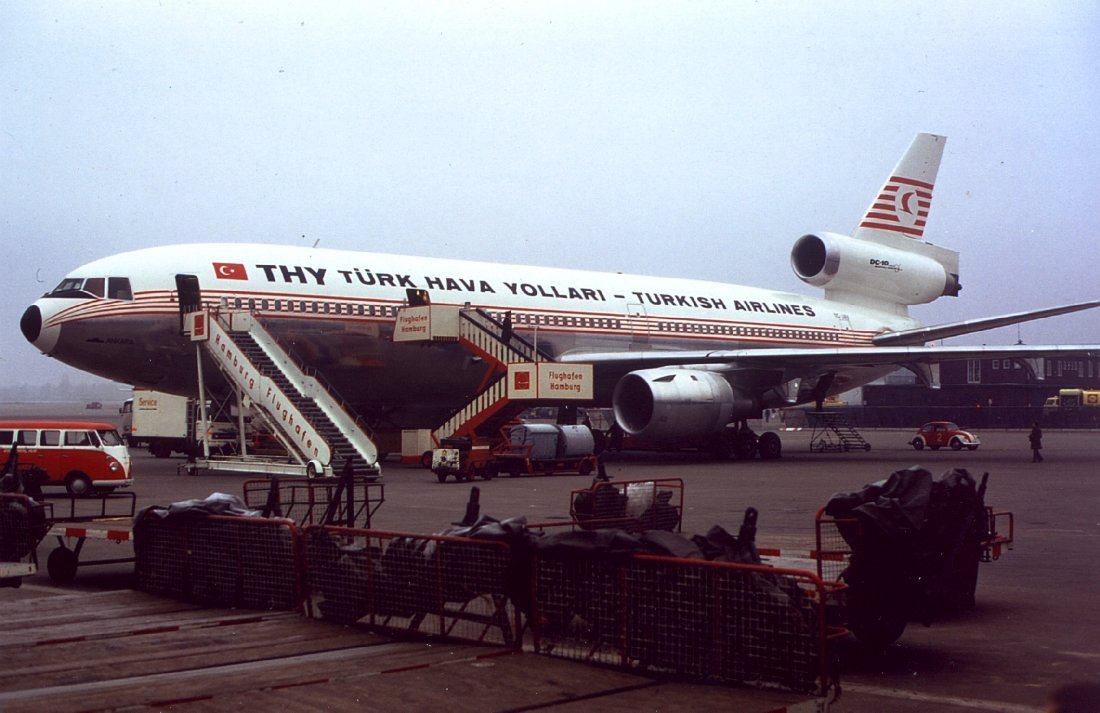
The ill-fated Turkish Airlines jet (Source: Airliners.net)
The DC-10 story is a graphic cautionary tale of the dangers of insufficient product testing and lack of transparency regarding such issues upon introducing new technology. The plane entered revenue service in mid-1971, less than a year after its maiden flight, and in less than a year after that its fatal design flaws were already apparent to investigators. In 1972 a near-tragic explosive decompression incident on board an American Airlines DC-10 exposed a dangerous design flaw in the plane's cargo bay doors. The problem was never corrected and less than two years later it surfaced again, this time with tragic consequences, on board Turkish Airlines Flight 981, when an explosive decompression resulted in the deaths of 346 people.

Following the Turkish Airlines disaster, an airworthiness directive was issued by the US' Federal Aviation Administration (FAA) and all DC-10s underwent mandatory door modifications. The aircraft continued to fly with major carriers for decades thereafter, but the plane's tainted reputation coupled with its direct competition with Lockheed's L-1011 resulted in far fewer sales than the company had originally projected. The company made a last-ditch attempt to inject new life into the model with a stretched and upgraded version, designated the MD-11, but its limited range relative to equivalent models by Boeing and Airbus saw it sell poorly. In 1996 McDonell Douglas was acquired by Boeing, sealing the latter's domination of America's civil aerospace business.

Fast forward to the present, the Boeing 787 was a full six years in the making before its maiden flight in 2009. Following its first flight, six test prototypes ran up some 4,645 flight hours in the jet. About a quarter of these hours were flown by FAA flight test crews, the agency. And while the investigation into recent problems with the jet are still underway, Boeing spokespersons have noted that the hugely popular 777 model experienced similar 'teething pains' in its first few years of operation. And this Friday the FAA formally announced its opinion that the Dreamliner jet is indeed safe to operate. And in its communication surrounding the disaster, Boeing has emphasized the rigourousness of the testing that went into the 787's development. It seems as though the 'lateness' of its introduction is now being used as a selling point by the company.

In its corporate values, Boeing states that "We will strive for continuous quality improvement in all that we do, so that we will rank among the world's premier industrial firms in customer, employee and community satisfaction." Judging by the company's swift actions this week and its communication of the issues surrounding its newest and most prized product, the company certainly looks like it's upholding this pledge.

Addendum (January 15)

Since the writing of this post, the problems with the Boeing 787 appear to have worsened. Today an All Nippon Airways 787 was forced to make an emergency landing after smoke was seen in the cockpit. Both ANA and Japan Airlines announced today that they are grounding their 787 fleets until further notice. A spokesperson for Boeing asserted that the company is fully aware of the situation and that it "will be working with our customer and the appropriate regulatory agencies."