Scottish historian Niall Ferguson has always been a provocative figure. Derided by many as a cultural chauvinist and a defender of western imperialism, he is equally praised as a prescient voice of honesty in a cultural realm permeated by political correctness. Over the course of his academic career, he has consistently positioned himself as a bête noire of the academic mainstream, be it by challenging orthodox ‘truths’ about the First World War (specifically that the war was largely the result of British belligerence) or taking unpopular stances such as supporting the 2003 invasion of Iraq or being, in Eric Hobsbawm’s words, a “nostalgist for empire.”
Fergie is in typically fighting form in his lecture at the Edinburgh TED Conference in July 2011. The lecture, based on his recent book Civilisation: The West and the Rest, attempt to explain the social and economic factors that set the western world apart from the rest of the world. Admittedly, there is something grating in his “I’m right and you’re not” tone in both the book and his lecture. Nevertheless, his basic assertion that ‘the west’ (specifically Europe, North America and Australasia) achieved its current – albeit now challenged – supremacy in the world by way of six ‘killer applications’ is a remarkably watertight argument.
Where Ferguson clashes with the more ‘politically correct’ scholars in regards to the ascendancy of the west is in his downplaying of the role of imperialism and colonial-era exploitation of the non-western world in achieving its edge. As Ferguson explains in his lecture at the Edinburgh TED Conference, empire cannot have been the primary reason because, in his own words, “empire was the least original thing the west did.” If imperial exploitation had indeed been the deciding factor, then the Ottomans, the Mughals, the Khmers and the Aztecs would have retained their edge into the modern world rather than have been relegated to the dustbin of history.
Secondly, Ferguson notes that the western world achieved its peak level of divergence from the non-western world in the 1960s and 1970s – well after the western powers had shed their colonial possessions. One of the most unsettling realities of post-colonial Africa in particular is the fact that many African countries (although certainly not all) enjoyed higher GDPs and standards of living under European colonialism than they have under self-rule. Were imperialism the primary culprit in the ‘great divergence’, in Ferguson’s words, surely this would not be the case
No, empire is not the cause of western supremacy. If anything, the style of empire patented by Europeans during the industrial era and beyond was a result of these societies’ advancements than a cause thereof. So what, then, gave the west its systematic edge? Ferguson identifies six ‘killer apps’ of western civilization – deceptively simple concepts with complex coding behind them – which he believes set the western world apart from the west. In his defence, he uses non-western as well as western sources in his argument. Moreover, he postulates that these ‘apps’ are very much open source and that the ‘resterners’ are starting to beat the westerners at their own game.
In his TED lecture, Ferguson challenges the listeners to add their own to the list or argue against any of the existing six, adding in his characteristic hubris that “You’ll be wrong.” You’re on, Fergie! But first, let’s look at the six that he proposes.
1) Competition

This one is straightforward enough. China, for example, held a systematic edge over the west in terms of civilizational development for many centuries, but a lack of forces in any position to compete with the monolithic stats structure of imperial China held it back when trailblazing commerce-driven economies in Europe began flexing their muscle around the world. Similarly, it was a lack of competition in the former Soviet Union and Maoist China that saw these realms continue to stagnate in the post-colonial world. It was not Buckingham Palace that did the grunt work of British expansionism. It was the likes of the East India Company and the Hudson Bay Company that did the job.
Some scholars have suggested that seed of Japan’s successful modernization in late 19th and early 20th century far ahead of China, Korea and other Asian civilizations was sewn with the bifurcation of imperial and political power between Kyoto and Edo (present-day Tokyo) thereby breaking the monopoly of power by the Kyoto aristocracy orbiting the imperial throne. In a similar fashion, the rise of modern China was presaged by the emergence of politically separate and economically dynamic entities in Hong Kong and Taiwan, which ended up serving as its post-Mao models.
2) Scientific Revolution
 This one again is a no-brainer. The western scientific revolution was of course made possible by advances in science and mathematics achieved in the non-western world, but by the time the industrial revolution took hold in Western Europe and North America scientific progress had stagnated in much of the rest of the world. In fact, as the scientific revolution began to take hold in Europe in the 16th century, the Islamic world, which had long held the edge, had already begun to take the reverse course, as seen in the destruction of Taqi al-Din’s observatory in Istanbul in 1580 at the behest of Ottoman clerics who considered it immoral to inquire into the mind of God.
Fortunately for the ‘resterners’, this scientific divergence is well on its way to being overcome, particularly in the case of East Asia. At the same time, however, many leading scientists in the west have raised concern about a growing ‘war on science’ in the west. This has largely been viewed as an American phenomenon, where Christian fundamentalism has long been vocal in its mistrust of and distain for the scientific community. However, Richard Dawkins and others contend that phobia of science in western society goes well beyond the American Bible Belt and threatens to stymie scientific progress in places that, like the Islamic world, once held an undisputed edge.
3) Private Property Rights

It’s not the democracy; it’s private property rights. This, Ferguson argues, is why countries like Canada and the US leapt ahead of Latin America, where land ownership was, and in many places still is, overwhelmingly dominated by a small white minority descended from the conquistadors. Private property rights, he asserts, has the result of magnifying the potential for economic growth by giving individuals greater incentive to develop their lands and engage in the economy. The prevalence of private land ownership in places like post WWII South Korea and Taiwan presaged these countries’ economic ascendancy while command economies like the USSR and China stagnated.
This third app might also offer a window into why so many of Canada’s First Nations have stagnated in the modern world. Under the Indian Act, reserve land ownership is the exclusive domain of band councils, essentially resembling miniature versions of old Soviet republics. Fortunately, hard-won land claim settlements by many First Nations have led to greater economic clout, according them the opportunity to circumvent the lack of this particular app in achieving prosperity and higher quality of life. In this case, private control over resources could well prove tantamount to property rights.
4) Modern Medicine

Fortunately for humankind as a whole, modern medicine has ceased to be a ‘western’ phenomenon and has become more or less universal, and the result has been staggering improvements in life expectancy and infant mortality rates worldwide. Moreover, innovation in medicine has ceased to be a western monopoly. If anything, the greatest resistance to ‘western’ medicine in the world today is to be found in the western world itself, where a phobia of doctors converges with religious fundamentalism and faddish alternative healing modalities to pose a potential threat to medical progress.
5) Consumer Society
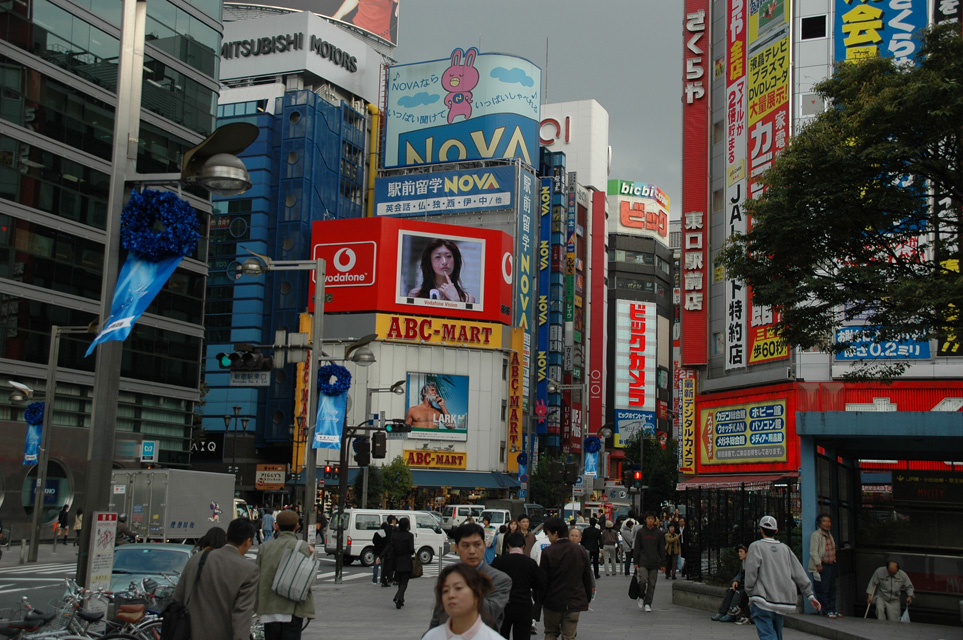 C'mon! Do we really need this one? Alas, it would seem that we do. Japan was the first non-western country to develop a modern-day consumer society in the early 20th century, which paralleled the country’s economic growth and improvement of living standards, and every society since that has made the jump from underdeveloped to developed status has also embraced various forms of this now largely ubiquitous phenomenon. When it comes down to it, human beings want their creature comforts – and this requires App #5.
The alternative to the consumer society, as Ferguson points out, was what Mohandas K. Gandhi proposed for India, which was essentially to universalize poverty. It scarcely needs saying that while the Mahatma remains a deeply revered figure in present-day India, few – if any – Indians would seriously advocate a return to his economic ideals. Indeed, the most vociferous critics of modern capitalism have generally all been products of their respective country’s economic elites who had already benefited from existing consumer societies. And while App #5 does appear to be out of control in much of the west, deleting it entirely would invariably be have disastrous social consequences.
6) Work Ethic

This one is without doubt the most problematic of all – and perhaps the most difficult to quantify. Nevertheless, statistics on hours worked and worker productivity speak to an overwhelming correlation between economic clout, standard of living and work ethic. This is not however an assertion that laziness on the part of non-western societies caused them to stagnate, although plenty of westerners have hinted at this. Human beings are extraordinarily industrious when they feel they have something to gain from their labour. The New Economic Policy implemented by Lenin in the USSR in the early 1920s allowed farmers to generate profit from small plots of land, plots which ended up producing far more food than all the collective farms put together.
As Ferguson points out, Max Weber postulated that ‘work ethic’ was a Protestant phenomenon. Needless to say, the ascendancy of the Tiger Economies of East Asia long put this argument to rest, and indeed now Asian statesmen like former Singaporean Prime Minister Lee Kuan Yew can be heard equating work ethic with ‘Confucian’ values. However, improved worker productivity has been shown to be universally correlated to the viability of vertical mobility and the capacity of societies to improve working conditions and infrastructure. Work ethic is, in sum, an indicator of the health of a society – not an innate characteristic that some societies lack and others possess.
The verdict?
It’s tough if not impossible to argue against any of these. Ferguson notably does not include democracy on this list, and on this I’m in agreement with him. After all, South Korea, Taiwan, Singapore and others achieved First World levels of economic clout and material prosperity under authoritarian rule and modern China appears to be well on its way to doing the same, while India stagnated for decades under democratic governance. Democracy, it would seem, facilitates the process. The overall correlation between material affluence, economic stature and democracy is self-evidence and indeed countries like South Korea have seen accelerated since becoming multiparty democracies. Nevertheless, democracy fails to make the cut.
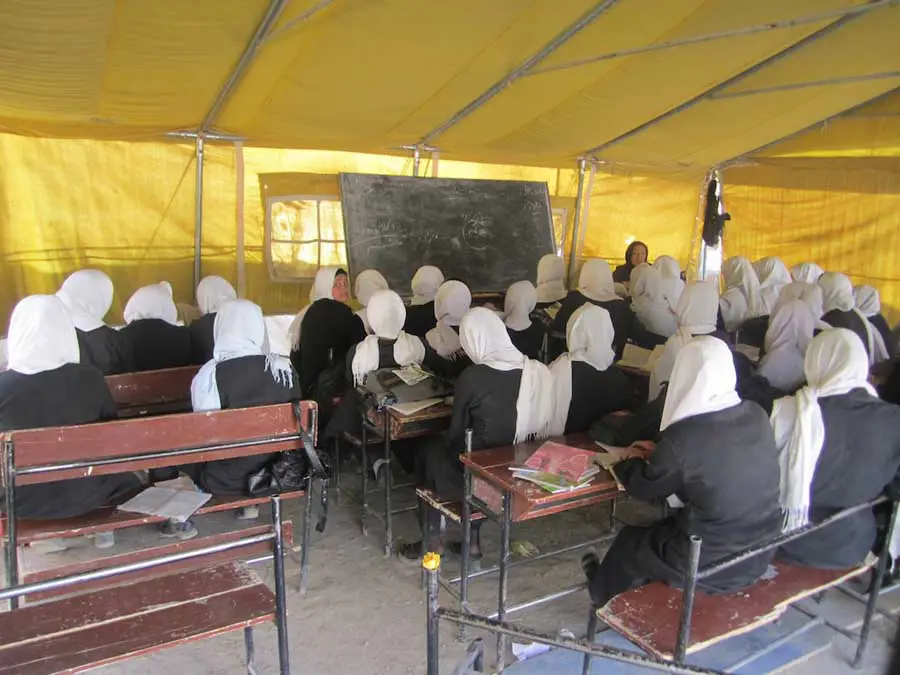 |
| App #7? |
The reason, he argues, is human capital, specifically the vast divergence in literacy levels between the two countries, as well as a pronounced imbalance between male and female literacy rates in India. It was this more than anything that paved the way for China`s post-Mao ascendency, and likewise the gains made by India on this front since the 1980s that presaged its now-impressive growth. Virtually every society that has made the jump from have-not to have status has paved the way through prioritizing education. High literacy rates certainly do not guarantee economic growth, as seen in the stagnation of many post-Soviet republics in spite of near-universal literacy, but I would challenge anyone to produce an example of a country that succeeded without it.
Over to you, Niall.