Showing posts with label Journalism. Show all posts

Saturday, 28 December 2013

Why Alberta Merits Two International Air Hubs

Source: dialogdesigns.ca
I've been meaning to write a response to Ed McDonald's opinion piece in the Edmonton Journal back on December 2 in which the self-described "professional airline pilot, professional engineer and aviation consultant" criticizes Edmonton International Airport's lofty ambitions to become a full-fledged global aviation hub to compete with Calgary International. In his article, McDonald alleges that Edmonton "never has been nor ever will be an airline hub, despite the promises and dreams two decades ago."

As a communications advisor for EIA, my job, among other things, is to iterate the opposing argument in keeping with the brand promise "more flights to more places." At least between 9 and 5, Monday to Friday, I have to do it because I'm paid to. But as an Edmontonian, and one fairly well acquainted with the issues facing the city's air transportation infrastructure, I also feel compelled to make the case in my free time. This, I should make clear, is not a piece of 'EIA' communication. These are purely my own views, albeit ones that are shared by a great many of the people I work with.

In his editorial, McDonald outlines two basic but different arguments. As one of Edmonton's die-hard City Centre Airport supporters (an issue that was finally laid to rest last month), he contends that Edmonton shot itself in the foot by closing its venerable municipal airport, and in doing so squandered an opportunity to establish itself as an important urban "spoke" airport akin to London or Toronto's City Centre Airports. He also makes the claim that Alberta, with its population of four million (as of this year), simply isn't big enough to support two major international airports, arguing that a single one requires a population base of at least three million.

Let's think about this for a moment. For starters, McDonald's argument appears to be self-contradictory in its allegation that Edmonton ought to have kept two airports open - in spite of the fact that the province as a whole doesn't have the population base to support two major airports. How does this make sense? Indeed, anybody well acquainted with Edmonton's modern history (and not emotionally over-attached to ECCA) will tell you that it was the city's failure to swiftly close and redevelop the Muni that both divided and undermined its status as an air hub, allowing Calgary to supersede what was once the undisputed air capital of the province, and hindered the city's downtown for decades by restricting building height, a factor in the mass exodus of corporate headquarters from the provincial capital to the province's now undisputed corporate capital to the south.

A Wagnerian opera finally over (source: Edmonton Journal)
Had the city of Edmonton closed City Centre Airport back in the 1960s following the construction of what was then (and still is) the second-largest airport in the country by land area, Edmonton might still be the province's primary air gateway. Certainly Edmonton's geographical position along the major transpolar air routes to both Europe and Asia and northerly position vis–à–vis Calgary (not to mention its proximity to major fuel refineries in Sherwood Park) still offer tangible benefits to air carriers, and had more corporate head offices remained in Edmonton, it's entirely likely that Calgary International Airport would have remained secondary to Edmonton had the city consolidated its air service early on and concentrated on building better transit links to the International.

But what's done is done, and with Edmonton's breakneck passenger growth over the past five years, it's clear that the airport's time has come once again. Which brings me to McDonald's second point, which is that Alberta, currently the fastest-growing province in the country, doesn't have the population base to support two international airports. Apart from the fact that his allegation is contradicted by the fact that Edmonton and Calgary are both enjoying both the fastest passenger growth in the country among major airports and the steadiest route expansion, this argument is also simply not supported by comparable international experience.

Three Overseas Parallels: Norway, Scotland and New Zealand

Were it an independent country, Alberta, with its four-million-strong population and thriving oil and gas economy, would be broadly comparable to Norway or Scotland. (Granted, the latter isn't technically an independent country, although it could potentially become one in 2014.) Norway, with its population of five million, its per-capita income of $55,000 and its booming energy industry, is arguably the overseas country that most closely resembles Alberta. It also, in stark contradiction to McDonald's assertion, maintains four international airports, each with passenger totals over four million, of which two (Oslo and Bergen) offer regular scheduled intercontinental air routes.

In the case of Norway, Oslo (Gandermoen) International Airport is by far the country's largest at 22 million annual passengers (and the second-largest in Scandinavia after Copenhagen), and offers routes to destinations all across Europe, as well as to intercontinental destinations like Bangkok, Cancun, Dubai, Goa, Islamabad, Lahore, New York (JFK and Newark), Oakland, Phuket, Seoul, Sharm el-Sheikh and Tel Aviv. Meanwhile, secondary hub Bergen (Flesland) International Airport, while significantly smaller than Oslo, carries nearly six million passengers a year to destinations that include New York, Tel Aviv and Tokyo as well as seasonal charters to Hiroshima and Gran Canaria. Meanwhile, third and fourth-rung airports in Stavanger and Trondheim offer extensive European connections.

The case of Scotland is equally instructive, and perhaps a better parallel to Alberta given the similar nature of the relationship between its two primary cities. At a population of 5.3 million, Scotland is also roughly comparable to Alberta population-wise, and its petroleum-oriented economy and northern latitude also makes it a logical comparison. It is also a country centred on two main urban regions, Edinburgh - the country's political and cultural capital, and Glasgow - its traditional economic hub. Scotland also has an important third city, Aberdeen, which, as the country's main North Sea oil industry hub, serves a role roughly analogous to Fort McMurray in Alberta.

Plenty to dance about at Glasgow International Airport
(Source: passengerterminaltoday.com)

Like Edmonton and Calgary, Edinburgh and Glasgow both have a metro areas of roughly a million people. And both cities also maintain thriving international airports, in spite of being far closer together geographically than Alberta's twin cities. With annual passenger totals of over nine million, Edinburgh International is Scotland's busiest airport and the sixth busiest in the UK - and the second busiest outside the greater London area. Edinburgh is also not hard up for intercontinental routes, enjoying non-stop connections to Cancun, Chicago, Doha, Marrakesh, New York, Orlando, Philadelphia and Toronto. Glasgow's airport is smaller, but only just (and growing faster than Edinburgh), serving over seven million a year - roughly the same number as Edmonton - to destinations that include Calgary, Dubai, Halifax, New York, Philadelphia, Toronto and Vancouver.

Another interesting overseas parallel to Alberta is New Zealand. At 4.5 million, New Zealand is only slightly more populous than Alberta, and is roughly the same size geographically. It is also a  prosperous resource-driven jurisdiction that shares Alberta's propensity for commodity-driven boom and bust cycles. In terms of air traffic, New Zealand has a primary international air hub in Auckland as well as a secondary international hub in Christchurch. As the main urban centre for New Zealand's South Island, Christchurch has maintained its role as an important aviation centre over various economic ups and downs (as well as two devastating earthquakes in 2011), and today enjoys non-stop connections to Bangkok, Dubai, Singapore, Tashkent and Tokyo, and with China Southern Airlines soon to commence non-stops to Guangzhou. So much for needing a minimum of three million people for a single international air hub.

What Edmonton Could Be: The Australian Example

So if size and location haven't held Edmonton back from becoming a bona-fide international hub, what has? The twin culprits, as many Edmontonians both inside and outside the industry know, are a hidebound national carrier determined to limit all of its international traffic in and out of Alberta to a single hub and a protectionist national aviation policy that has worked to limit international carriers' landing rights at Canadian airports. (These problems are further compounded by prohibitive landing fees and tariffs which conspire to make Canadian airports uncompetitive internationally - and drive as many as five million Canadians to stateside airports like Bellingham and Buffalo in pursuit of cheaper fares.)

What would Edmonton's airport look like were Canada to loosen its protectionist airline policies and ease the financial burden on its airports? While Bergen and Glasgow are still worthwhile points of comparison, the best parallel is to be found in the Asia-Pacific country most readily comparable to Canada.

YEG Down Under? (source: good-wallpapers.com)
Adelaide, the capital of the state of South Australia, is very much the Edmonton of Australia. It's the country's fifth-largest city and has a similar population at 1.2 million. Like Edmonton it is also home to the country's fifth busiest airport, and one that, like EIA, serves a strategically important function as the closest air gateway to the country's mining sector, largely concentrated in country's vast geographic centre, straddling South Australia, the Northern Territory and Western Australia. It is also similar to Edmonton inasmuch as the country's national carrier, Qantas, has always made it a policy to use Adelaide International as a "spoke" rather than a hub, opting to funnel international traffic through its main hubs in Sydney, Melbourne and Perth.

However, the Australian government's embrace of open skies legislation broke Qantas' monopoly on international flights to and from Down Under, and with that opened up opportunities for the city of Adelaide. Result? By June 2013 Adelaide was enjoying year-on-year international traffic growth of a staggering 14.8 per cent and now has non-stop flight to Dubai with Emirates, Hong Kong with Cathay Pacific, Kuala Lumpur with Malaysia Airlines and Air Asia X and Singapore with Singapore Airlines, as well as Bali (Denpasar) and Auckland with Aussie low-cost carrier Jetstar, which this year established a new pilot and cabin crew base at Adelaide - a clear sign of things to come at this growing air hub.

At the risk of milking the Edmonton-Adelaide parallel to death, the two cities share a remarkable amount in common. Adelaide, in spite of long being Australia's 'forgotten' city, is an industrial city known known increasingly  for its thriving arts sector and festival scene (the Adelaide Fringe Festival is the largest arts festival in the southern hemisphere). In terms of liveability Adelaide as been repeatedly listed in the Top 10 of The Economist's World's Most Liveable Cities index, and has also been repeatedly ranked as the most liveable city in Australia by the Property Council of Australia. In other words, it's the city people tend to forget about unless they actually live there, in which case they can't imagine living anywhere else. Sound familiar?

Conclusions?

Cities like Adelaide, Bergen, Christchurch, Glasgow and Edmonton all clearly have the demand, and the need, for good international air service. It's also colossally myopic - and frankly untrue - to assume that such air service necessarily comes at the expense of other centres, or in Edmonton's case Calgary. The numbers clearly indicate otherwise. Of Canada's major airports, Edmonton was the fastest growing in 2012 at 6.4 per cent. The second fastest growing? Calgary at 6.0 per cent. Similar trends can be seen elsewhere. In Norway, Oslo-Gandermoen grew by 4.8 per cent in 2011-2012 while Bergen-Flesland grew by 3.8 per cent over the same period. Meanwhile in Australia, overall traffic at Adelaide actually dropped in 2011-2012 (due to the collapse of domestic carrier Tiger Airways) but international traffic surged across the Big Five airports, even as the country's largest carrier continues to suffer labour difficulties and sliding profits.

Rovinescu: he's not your boyfriend (source: Toronto Star)
Last month in Vancouver, Air Canada CEO Calin Rovinescu rebutted Vancouver International Airport's calls for open skies legislation, arguing that unrestricted competition in the airline industry would harm Canadian business interests and reduce airports like YVR into 'feeder' airports for global carriers. In it he specifically mentioned the Australian case, in which he alleged that the country's open skies policies had effectively allowed Emirates to run roughshod over its airline industry. "Now, there is a choice for Australian customers (travelling abroad), as long as their choice is Dubai," he said. Personally I have my doubts that many Australians outside the Qantas board room share his sentiments, particularly in cities like Adelaide where, until recently, the only choices for international travel were Sydney, Melbourne or Perth.

This is the situation Edmontonians continue to face. Although a major victory was achieved this fall with Icelandair's new Edmonton-Reykjavik non-stop, our flag carrier's refusal to offer any international non-stops out of Edmonton (apart from the now-downgraded London-Heathrow service) and the federal government's still restrictive policies regarding international carriers, comes at a colossal disadvantage for non-traditional hub cities like Edmonton. Not only would we love to have more intercontinental non-stops out of Edmonton, but we've shown we can support it. Statistics from the UK's Civil Aviation Authority clearly show that Air Canada's Edmonton-London flights have remained competitive compared with comparable flights out of Calgary and other centres, in spite of claims to the contrary, and early sales for the Icelandair's services out of Edmonton were enough to persuade the airline to launch the route earlier than previously planned.

None of this need come at the expense of Calgary's steady aviation growth, and there is clearly a need for two major airports in this province. While YYC and YEG will invariably continue to joust for passengers and routes, at the end of the day the two airport authorities are on the same team, as both are important drivers of Alberta's economy. Ed McDonald's view of the Alberta aviation scene might have held water back in the 1970s when the province's population first cracked the two-million mark, but it's clearly woefully out of date now, contradicted by both local demand and international parallels.

More flights to more places: it's not just a corporate mantra. It's a raison d'être. And while we at EIA will invariably continue taking pot shots at our rivals down the QEII, at the end of the day what's good for Edmonton is also good for Calgary. Open skies legislation may not be good Air Canada share prices, but more choices for Canadian air travellers and overseas business people and tourists wanting to come to Canada is a good thing all around. And at the end of the day, isn't that the whole point of aviation?

Thursday, 31 January 2013

Bullshit News Story of the Week: Nobel Peace Prize "Nominee" Takes On Obama

"I've seen the future, brother - it is murder." (Source: teaparty.org)

Ever thought you deserved a Nobel Peace Prize? Turns out being nominated for one is not that hard. All you need apparently is convince a university rector or a professor of social sciences, history, philosophy, law or theology, or a director of a peace research or foreign policy institute, to submit a nomination on your behalf. Don't believe me? See for yourself.

Not that this actually means anything, of course. While nobody outside the Nobel Society knows exactly how many submissions for the Peace Prize it receives every year, as this information is officially embargoed for a 50-year period, but one can safely assume that it runs into the thousands. And with many of the world's leading peace advocates from Malala Yousefzai to Bono still waiting for their kick at the can, it's safe to assume that you don't have the remotest shot at the big prize. (Unless of course Bono or Malala is reading this post, in which case I wish you all the best!)

Having said that, once your application is in the bag you are fully entitled to refer to yourself as a Nobel Peace Prize nominee. And while this is an essentially meaningless designation, this hasn't stopped some nominees from bandying about this designation. Moreover, in some benighted corners of our media landscape, namely the US Tea Party movement, being a Peace Prize nominee is considered an impressive credential - or at least deemed sufficient to fool the ignorant souls that constitute the movement's rank-and-file followers.

On January 22, the big-government-conspiracy-obsessed "news" portal Prison Planet run by barking-mad media wingnut Alex Jones produced a story with the title "Nobel Peace Prize Nominee: Obama Asks Military Leaders If They Will 'Fire On US Citizens'." Naturally, the Tea Party movement's official web portal latched onto this story like a falcon on a three-legged hamster and made it headline news. The story alleges that an unnamed individual described only as "one of America’s foremost military heroes" leaked this information to a "Nobel Peace Prize nominee." The Peace Prize candidate in question further elaborated on this exchange on his personal Facebook page with the following:

"I have just been informed by a former senior military leader that Obama is using a new "litmus test" in determining who will stay and who must go in his military leaders. The new litmus test of leadership in the military is if they will fire on US citizens or not. Those who will not are being removed."
So who is this great advocate of peace, who the article further emphasizes is "a public figure, not an anonymous voice on the Internet"? The man in question is Guelph, Ontario native Dr. Jim Garrow. According to the Guelph Mercury, he's a former principal, school board trustee and special needs teacher who once created his own "Internet business" and ran a flight school. However, Garrow is best known for being the director of an organization known as Pink Pagoda, which works to rescue unwanted baby girls from China and put them up for adoption in North American homes. Dr. Garrow claims his organization has saved 34,000 baby girls since 2000.

On the other hand, he does look like a convincing Tolkien wizard.
Peace Prize worthy, you say? Not so much. The Guelph Mercury article goes on to explain that many of Garrow's claims have been disputed by individuals familiar with China's adoption networks. It also turns out Pink Pagoda isn't even a registered charity and that Garrow's activities have prompted an investigation by the RCMP for alleged child trafficking. China adoption expert Brian Stuy produced a damning expose on Garrow and his organization on his blog Research-China.org in which he asserts that the number of children he claims to have rescued "represents approximately half of all the children adopted internationally from China since 2000," while speculating that Garrow may have unwittingly become ensnared in illegal 'child-buying' rackets involving corrupt local officials. He further notes that reporters from the New York Times, Los Angeles Times and Dateline have investigated his activities and found no substantiation to his claims.

As for Garrow's much-vaunted "Peace Prize nominee" status, it turns out he was nominated for the prize in 2009 by an unnamed president of a Chinese university whose granddaughter was allegedly rescued by Pink Pagoda agents. He also goes by the honorific "Dr.," a designation he received as an honourary degree from the non-accredited North Carolina College of Theology, which apparently declined to respond to the newspaper's phone inquiries into Garrow's educational background. As for his teaching background, his record is checkered to say the least. His teaching licence in Athens, Ontario was suspended for a time following allegations of professional misconduct. His short-lived flight school was shut down after it was discovered the plane it was using was not insured or registered.

This, in a nutshell, is the great "public figure" used by the Tea Party to support its assertion that President Obama is priming members of the US army to fire on its own citizenry, presumably in an attempt to forcibly remove privately owned firearms from the "cold dead hands" of the American people. Of course there is no explanation as to how Garrow chanced to hear this remark from the unnamed "American hero" in question, or even why a Canadian leader of an international adoption agency based out of China (even a competant one) would be an authoritative source of information on a US president gone rogue. Of course the only information we're given about Garrow in the Prison Planet article picked up by the Tea Partiers is that he's a "Nobel Peace Prize nominee" and that he has saved children's lives, presumably in the hope that the reader will take this at face value and not explore it any further.

In the meantime, I am officially not soliciting nominations for the Nobel Peace Prize. Puh-lease! I want no part in an award that's been bestowed on war criminals like Henry Kissinger and Yasser Arafat. And had the likes of "Dr" Jim Garrow as nominees. Nope, not goin' there!

Wednesday, 25 July 2012

10 Ways Not To Be A Pompous Jerk (A Response to Jerry Agar of the Toronto Sun)

Yesterday I came across an article in the Toronto Sun that made my blood boil. The article, which was entitled '10 Ways Not To Be Poor', began with the opening salvo "The perpetually poor are not blameless." (Right off the bat you know where this train is going.) Sun columnist and 'conservative radio personality' Jerry Agar then proceeds to offer ten pearls of wisdom as to how to avoid being chronically destitute, such as don't see life is a lottery, don't set low goals and learn how to "manage your emotions." Thanks Mr. Spock. That's really useful!

Of course, Mr. Agar makes no mention of extenuating factors such as mental illness, physical ailments, domestic violence, inadequate public transportation, public safety concerns (in many cities) and other problems that contribute to trapping people in poverty. Nor does he acknowledge the importance of community organizations, educational programs and cultural institutions (all of which depend on government support for their existence) in helping people break free of the poverty trap. Moreover, he derides "pop culture and self-help programs" for instilling a culture of "wishing and hoping" while simultaneously spewing out a parade of platitudes taken straight from a third-rate self help book. Sometimes the irony truly writes itself.

What really gets me about this article, though, is what its actual intended purpose is. Imagine, for a moment, that you are a poverty-stricken person with two jobs, three kids to feed, a Mount Kilimanjaro-sized pile of bills on the kitchen table, disconnected power and an impacted molar that you can't afford to get fixed. You pick up the Sun at your bus stop at 11:00 pm on your way home and you read Jerry Agar's column, which its sage advice such as "God helps those who help themselves" and "Some low-income people find a way to save for the future, but they do so by foregoing $300 Nike shoes." Is there a single low-income person thus far who has read that article and thought to themselves, "Wow, I hadn't thought of that! I see the error in my ways!" I doubt even Jerry Agar can imagine such an occurrence.

Why, then, did he choose to inflict this article on the public? On this blog I make a conscious effort to write things that are either a) entertaining, b) enlightening, or c) a bit of both. Agar's column is none of the above, which to my mind leaves only two options. One - he could be deliberately trying to piss off his readers for pure shock value. Two - he's engaging in classic right-wing journalistic masturbation aimed at readers who enjoy nothing more than stewing in their own smug sense of superiority over those 'silly' poor people are 'silly', while simultaneously giving them an outlet for their righteous indignation over tax dollars going to social programs designed to help people who don't ever 'help themselves'. The first I can respect, although he's a far cry from a Christopher Hitchens in the wit department. The second I just can't get behind.

With that in mind, here is a Top Ten of my own dedicated to Jerry Agar and others like him. Call it 10 Ways Not To Be An Asshole Columnist, or something like that.

1) Ask yourself what the point of your article is. And unless it actually enlightens, entertains or shocks (in an entertaining or clever manner), think perhaps about writing something else.

2) Back up your facts when you make accusations. For example, if you're going to accuse poor people of mismanaging their finances (or buying athletic footwear that they can't afford), have at least some anecdotal evidence.

3) Try not to make the same point again and again while pretending they're different points. For example, "believing in the quick fix," "believing life itself is a lottery" and "believing in wishing and hoping" are, if I'm not mistaken, the same point worded in three different ways. That's annoying, and not to mention a transparently cheap way of padding your points to reach the number ten.

4) Don't make crass assumptions about people you don't know. When you say things like "Stay off illegal drugs and off alcohol if it causes problems in your life" you're essentially insinuating that everyone who is poor is an addict, which results in deepening existing stigmas against marginalized groups, thereby lessening people's likelihood of breaking out of poverty. (OK, this is kind of the same point as number two, but so important that I think it's worth mentioning twice.)

5) Don't insult your reader by stating the obvious. When you spout crap like "Drunks are bad at self-analysis," not only do you sound like an idiot but you're most likely to alienate your readership - unless your reader is of exactly the same mind as yourself, in which case they have no need for this article.

6) Don't foist advice on people that isn't really advice. If, for example, you say "Don’t have children until you are able to financially care for them" and your reader is an 18-year-old single mom struggling to get by, what do you expect her to do? Un-birth her child? Oh, and accusing her of being a 'child abuser' doesn't help.

7) If you're going to invoke scripture, do it properly. As my old pal Tyler Gingrich (aka The Political Pastor) pointed out to me, the line "God helps those who help themselves" is nowhere to be found in the Bible. In fact, many if not most Christians consider these words to be contrary to the Biblical message of God's grace. If nothing else, it's a tired cliche that doesn't really mean anything but is so prevalent that most people assume it's in the Good Book. It isn't.

8) If you're going to criticize government policy, offer some potential alternatives. As opposed to simply saying "We’ve spent billions on a “war on poverty” to negligible effect as there are still huge numbers of poor people" and "Perhaps we should demand more from people who stay on public support for decades and for successive generations," it would perhaps be more beneficial to offer some alternative strategies. To not do so suggests that you have no more idea than anyone else what to do to resolve the problem of inequality in our society.

9) Offering links to useful sources would be nice. The great thing about the Internet is that you can create links to other useful sources of information. And when it comes to a hugely consequential issue like poverty, you would think that the author would provide some 'further information'. Nobody's asking you to be an expert on everything. But it would be nice if you'd give credit to people who know more than you do on the subject, and have more to offer readers who are struggling to improve their lot in life.

10) Please stop repeating the line "It is not too much to ask." That's just annoying.

I should probably qualify all this by saying that I don't disagree with the assertion that individual bad decisions are a factor that contributes to the cycle of poverty. Nor am I some loony leftist whose response to everything is throwing more money at the problem. In fact, I do believe that we are a culture with a huge sense of entitlement much of the time, a characteristic that both the ideological left and the ideological right display in abundance - albeit of a different plumage. The ideological left expects government to coddle society. The ideological right gets incensed when asked to fork out for anything that doesn't directly apply to the individual taxpayer's narrow set of circumstances, such as alleviating poverty, solving the climate crisis or keeping ballet companies from going bankrupt.

Poverty is a colossally complex problem with innumerable factors, some of which are derived by personal behaviour and others that are tied to institutionalized inequality of one sort or another. My fundamental problem with the article in question is that it insinuates that all of us are born into this world with equal opportunities and that 'privilege' - be it of the racial, gender or socioeconomic variety - does not exist. I most strongly disagree and I would love to hear Jerry Agar's argument to the contrary.

Incidentally, your comments - bouquets and brickbats alike - are more than welcome. And Jerry, if you're reading this, I invite you with open arms to respond. And please be nice. It's not too much to ask.

Thursday, 7 June 2012

7 Tips For Writing Destination Articles On Places You've Never Visited


I used to do a lot of travel writing. When I lived in Tokyo, I had an assortment of semi-regular clients for whom I would write 'destination pieces' pertaining to Japan. While I don't get many of these at present (Edmonton isn't quite the blue-chip destination that Tokyo is), I do get the occasional one from old clients. This week I was approached by the editor of SilverKris, Singapore Airlines' in-flight magazine, about an article on Toronto. I, of course, don't live in Toronto and actually haven't really spent that much time there, but given my prior relationship with the magazine, my passing familiarity with Canada's 'Centre of the Universe' and the fact that I have numerous friends and colleagues there, I took the job on.

While I am somewhat familiar with Toronto, having visited the city several times, there have been instances - and this is my dirty little secret as a writer - where I've written articles on places I've never actually been to. Is this dishonest? I don't really think so. After all, I've never misrepresented my own travel experience to get a gig and in cases like this I've been upfront that I a) haven't been to the location the editor wants the scoop on, and b) won't be able to unless they pay me a enough that I am able to take the time off work, go to said location, write about it and still make money on the whole deal. That hasn't happened yet. Perhaps I'm writing for the wrong people.

While there are no doubt editors out there who would choke on my commentary here (and I'm hoping I don't lose clients by writing this), my stance is that there is nothing wrong with writing travel pieces on destinations that you personally have never visited as long as you're honest about it and you really do your research. Having said that, you do have to be careful, and there have certainly been cases in the past where I've decided that I was in no way qualified to write a particular destination piece and have turned the offer down. When it comes to making a decision on whether to take on an assignment I have my own personal guidelines. Here are my seven rules. I would be interested in hear what any other writers have to say on the subject.

Nope, haven't been here.
1) Don't go too far out of your depth.

There's only been one case where I've written a destination piece on a country I'd never visited. It was an article written for Air New Zealand for Tokyo Weekender where I was asked to profile the city of Auckland. I've never been to New Zealand and I was upfront about it, but for whatever reason they still wanted me to do it. But apart from this one case, I've only ever written about destinations I've never visited when I was already very familiar with the country and region in question and could draw at least somewhat on my own experience. You could probably write about Jasper National Park without going there if you've been to Banff or Waterton and have a grasp of Canada's Rocky Mountain Parks in general. Writing about Jammu and Kashmir without having been anywhere in northern India - that's a different story.

2) Talk to at least two different people who know it well.

This also applies to writing about a place you kind of know but haven't spent a great deal of time in. Get a second opinion. And especially if you've never been there, get a second and a third opinion, lest you be stuck with a singular viewpoint that you can't actually back up. My advice would be to find two people of different backgrounds who know a place - perhaps one native-born resident and one ex-pat. Possibly both a male and female view of the place. Get creative. If you don't know anyone from somewhere, call a local travel bureau and find someone to talk to.

3) Do your homework.

It goes without saying that you need to do your research for any travel destination piece, even one that you know intimately. Ownerships change, restaurants go out of business, people change phone numbers, new train and bus services are added - you need to stay current. This applies all the more when you're writing about a place you don't know very well - or don't know at all. Get to know the history of the place. Get to know its character. Familiarize yourself with every facet of the place that you can - everything short of physically going there. And wherever possible, immerse yourself in photographs of the place, which will help you flesh your writing out with physical description of things.

4) Use quotes from famous locals, noted authors etc.

Don't have any personal anecdotes about a place? Use other people's. I once wrote an article about famous ryokans (traditional inns) in Japan and wasn't able to get to all of them in person, but it proved to be not too difficult to dig into their histories and find out what famous people had visited them, and what certain poets of yesteryear had written about the surrounding region. Fill your writing with as much local colour as you can and say something like, "Don't take my word for it; the poet Basho thought this place was the BOMB!"

5) Profile things that don't required first-hand, on-site knowledge.

Haven't been here either.
Are there any big travel promotions on that pertain to the place you're writing about? Any new air connections, train services, tourist campaigns etc.? In the absence of a wealth of first-hand knowledge, go with information that your reader is going to want but that don't require in-depth knowledge. Remember that if your reader is engrossed in the article, they're likely actually interested in going to the place in question, which means they're going to want to know how to get there, how to get around, how can I economize while I'm there and are there any special events I need to check out. And for all of these, you can provide extensive information without having to go there yourself.

And if there aren't any special events or anything noteworthy going on, it's worth asking yourself if this particular destination is worth covering at all.

6) Check your facts after you're done.

Again, this really should go without saying. By this point, you should have established good working relations with your field sources. Run your draft by them and make sure what you're saying makes sense and actually applies. And again, if possible, get a second and possibly a third opinion.

7) If at all possible, do actually go there - even if only for a couple of hours.

To be fair, this is often impossible, but when I lived in Tokyo it was sometimes feasible to make a very quick trip someplace, get off the train, have a quick look around, find two or three interesting and/or quirky things to write about, grab a handful of brochures and go straight back to the big smoke. There were times where I didn't even leave the vicinity of the main railway station and was still able to get a quick sense of the vibe of a place - before grabbing a few brochures, talking to a few people in the local tourist office and then leaving. That's not going to be possible everywhere (namely in Canada), but wherever possible you should find a way to actually go somewhere, even if it's for a split-second in travel terms. If nothing else, it'll make the assignment easier.

For your reading pleasure, here's the article I wrote on Japan's historic ryokan back in the summer of 2008. Hint: of the six inns profiled in the article, I was only actually able to visit three of them. I would be curious to know if you can guess which ones they were.

Wednesday, 23 May 2012

Split Between PR and Journalism? Why Not Do Both?


It's official! CareerCast.com's recent ranking of the best 200 occupations in the United States echoed what many have been saying about the state of journalistic profession in North America for a long time, ranking 'newspaper reporter' a paltry 196 out of 200 professions. (In case you were wondering, 'lumberjack' was ranked #100 and software engineer #1.)

Public relations executive, meanwhile, was ranked at #70. The U.S. News and World Report ranked it even higher at #41, noting that the average annual salary for a US PR exec is an impressive US$91,810. The CareerCast survey did, however, note that it was the seventh most stressful profession in the country, following enlisted military soldier, firefighter, airline pilot, military general, police officer and event coordinator. Nobody ever said life was easy on the 'dark side'.

Not surprisingly, news of journalism being the fifth-worst job in the US swept the journalistic community, with reactions ranging from indignation to a sort of masochistic embrace of the aforementioned ranking as a badge of honour. Others still retorted along the lines of,"well, it may not be great, but at least I'm not in public f*cking relations!"

There is more than a modicum of disdain for the PR profession among the ranks of journalists. PR execs, we are told, are the Sith Lords to the noble Jedis of the press. The journalists who migrated to public relations are the turncoats, the Sarumans corrupted by money. Even some ex-journos within the PR profession can be heard making similar remarks. An anonymous journalist quoted a colleague who made the jump as saying, "I miss [journalism] every day, except twice a month - pay day."

Today, Ragan's PR Daily published an excellent piece by Aurora University Communications Director Dave Parro entitled '8 Reasons Journalists Should Consider PR'. While he didn't specifically cite the elephant in the room (money), he did provide eight compelling reasons why public relations has many of the same appeals of the journalistic profession except without many of the downsides that have made so many journalists demoralized. The reasons he cites are as follows:

  • You still get to tell great stories.
  • You get to shape the story.
  • You get to be an advocate.
  • You still get to regularly learn something new.
  • You don’t have the emotional baggage.
  • You get to be optimistic.
  • You still have constant deadlines.
  • You understand what makes a great story.

Of these eight points, number three is perhaps the most counterintuitive to many journalists with a jaded view of public relations. PR people for the most part gravitate to organizations whose mission and goals are aligned with their own. While this isn't always the case, at least early on in a PR career, it's certainly the ideal situation for anybody in the profession, and it goes without saying that the most effective PR professional is one who is highly engaged and committed to the cause of an organization.

Likewise, the best journalists are more often than not people who are dedicated to a specific set of issues and pursue it day in, day out. And given the ever-more monopolized and corporatized nature of newspaper ownership and the effect this has on editorial content, it is tempting to suggest that journalism is the wrong place to be for a person with strong convictions and a desire to tell difficult and not-always-popular stories. For people like these, could the 'dark side' in fact be the best road to take?

However, I maintain that this Manichaean view of journalism and PR isn't necessarily the case. Why couldn't one do both? After all, the advent of blogging and citizen journalism means that anyone who can write and conduct and interview can do 'journalism'. Granted, there are limitations to what one can do in this capacity. As an independent journalist you don't have access to the same resources that a reporter for a major newspaper has, and as a PR professional you don't want to be doing independent work that conflicts with your obligations to your employers or clients. Moreover, your connection to a specific organization can potentially be a liability, depending on where you work and what you're reporting on.

On the other hand, provided you avoid any potential conflicts of interest (which ideally is a non-issue due to the focal points of your work aligning with what you care about), this is as close as you're going to get to living the superhero dream while still upholding your adult responsibilities. In the comic book world, Clark Kent and Peter Parker supported themselves as reporters while serving as flamboyantly costumed public advocates of justice in an extracurricular capacity. Today's Kents and Parkers are invariably PR guys by day and online caped crusaders against ignorance and misinformation by night, one Tweet and blog post at a time. Many of them even have their own costumes, which they wear to blogger conventions.

The downside to this? In the list of the most stressful professions, 'superhero' was conspicuously absent, but one can only imagine that given the demands of the job it probably outranks even soldier and firefighter. And if PR exec is already at number seven, adding 'citizen journalist' to your mantle is unlikely to bring that down at all. But if you're an adrenaline junkie who cares a hell of a lot and can survive on three hours' sleep, go for it! You might want to come up with a catchy pseudonym first, though.

Monday, 16 April 2012

Jock Talk: Don Carman's List of 37 Annoying Baseball Clichés

PHILADELPHIA PHILLIES - Don Carman #396 DONRUSS 1989 MLB Baseball Trading Card
"I'd rather be lucky than good." - D.C.
Professional athletes aren't generally known for being the world's most skilled communicators. Sports interviews tend to be mind-numbing affairs along the lines "Well, uh, we've got a lot of momentum going, and we just need to keep it together as a team and go out there and score lots of goals and hopefully come out on top." There you go: 34 words (35 if you count 'uh') which said absolutely nothing. Why sportscasters even bother interviewing a lot of these guys is frankly beyond me.

It would, however, be unfair to blame the intelligence of these highly paid athletes for the vapidity of most sports interviews. A great many athletes, particularly in the football, baseball and basketball worlds, are college-educated and far from unintelligent. Even professional hockey players are today a far cry from the toothless Big Bobby Clobber stereotype of yesteryear. However, the absurd amounts of money invested in today's professional sports leagues make sports communications a very sensitive, risk-averse business. In this world nobody wants to rattle the hornet's nests. Even the mildest of taunts (as was evident in the recent LA Kings Twitter controversy) has the capacity to cause fallout.

The upshot of this hyper-sensitive communications landscape is that most athletes don't dare say anything even remotely controversial, hence the proliferation of tired sports clichés. (It doesn't help either that sports journalists tend to ask the same tired old questions.) But this hasn't prevented some of sports world's smarter and more sarcastic standouts from making jock talk work for them - and even making a mockery of such banter. And nobody did this better than former Major League pitcher Don Carman - a man who, in my opinion, deserves to be inducted into baseball's Hall of Fame for excellence in sports smart-assery.

Don Carman was a lefty who enjoyed a moderately successful career between 1983 and 1992, mostly with the Philadelphia Phillies as well as briefly with the Cincinnati Reds and the Texas Rangers. He had occasional flashes of brilliance on the mound, with four complete-game shutouts and once taking a perfect game into the ninth inning before giving up a single hit. He was also a famously smart guy who ended up becoming a sports psychologist in his post-baseball life, and was renowned for his dry sense of humour. His wit became legendary following a particularly bad outing in 1990 when he posted this list of quintessential baseball clichés on his locker in anticipation of a round of vapid sporting press interrogation.

"You saw the game. Take what you need.”

  1. I’m just glad to be here. I just want to help the club any way I can.
  2. Baseball’s a funny game.
  3. I’d rather be lucky than good.
  4. We’re going to take the season one game at a time.
  5. You’re only as good as your last game (last at-bat).
  6. This game has really changed.
  7. If we stay healthy we should be right there.
  8. It takes 24 (25) players.
  9. We need two more players to take us over the top: Babe Ruth and Lou Gehrig.
  10. We have a different hero every day.
  11. We’ll get ‘em tomorrow.
  12. This team seems ready to gel.
  13. With a couple breaks, we win that game.
  14. That All-Star voting is a joke.
  15. The catcher and I were on the same wavelength.
  16. I just went right at ‘em.
  17. I did my best, and that’s all I can do.
  18. You just can’t pitch behind.
  19. That’s the name of the game.
  20. We’ve got to have fun.
  21. I didn’t have my good stuff, but I battled ‘em.
  22. Give the guy some credit; he hit a good pitch.
  23. Hey, we were due to catch a break or two.
  24. Yes.
  25. No.
  26. That’s why they pay him _____ million dollars.
  27. Even I could have hit that pitch.
  28. I know you are, but what am I?
  29. I was getting my off-speed stuff over so they couldn’t sit on the fastball.
  30. I had my at ‘em ball going today.
  31. I had some great plays made behind me tonight.
  32. I couldn’t have done it without my teammates.
  33. You saw it … write it.
  34. I just wanted to go as hard as I could as long as I could.
  35. I’m seeing the ball real good.
  36. I hit that ball good.
  37. I don’t get paid to hit.
We miss you, Don!

Monday, 28 November 2011

Travel Archives: Ghost Hunting in Waterton Park


My "career" as a newspaper reporter lasted all of three months. It was the middle of 2008 and my wife and I were freshly returned from Japan when I worked for a brief stint as a reporter for the Waterton Boundary, a small summer weekly produced by the Pincher Creek Echo for distribution in Waterton Lakes National Park. If nothing else, it was a lot of fun. I got to photograph mountain goats, interview Parks Canada people and scold tourists for feeding the local deer - not things I get to do very often in my current line of work here in Edmonton. And for three months, I got to spend my working days in one of the most beautiful corners of North America.

Waterton, for those who don't know it, is Alberta's forgotten and most underrated national park. A far smaller park than Banff or Jasper, it nonetheless packs more wilderness per square inch than anywhere else in the country while remaining refreshingly free of the sort of aggressive commercialization you find in the province's better known mountain parks. It also has a fascinating human history, replete with tales of shipwrecks, bootleggers, dance halls, scandals and - yes - ghost lore. Waterton's iconic Prince of Wales Hotel, one of Alberta's grandest lodgings, is also one of the province's most famously haunted buildings, and during my summer in Waterton the hotel's manager was kind enough to give me a personalized guided tour of the place.

Did I see any ghosts, you ask? Alas, any disembodied souls that might have been loitering in the building were nowhere to be seen when I showed up. But the owner did give me plenty of material. Here is the article I wrote for the Boundary following my stroll through Waterton's haunted mansion.

Haunted Hotel: Ghost Stories from the Prince of Wales

(Waterton Boundary, August 29, 2008)

The Prince of Wales Hotel is one of Alberta and the Canadian Rockies’ most celebrated architectural landmarks. Built between 1926 and 1927, the Prince of Wales counts among the grandest of Canada’s grand railway hotels, standing alongside Quebec City’s Château Frontenac, Victoria’s Empress Hotel and the Banff Springs Hotel not far to the north

Sitting atop a windswept hill overlooking Upper Waterton Lake, the 80-year-old edifice is regularly battered by gale-force winds that rattle windows and rock the building back and forth, making creaking and whistling sounds through sliver-sized joints or cracks in the wood and in extreme cases slamming doors shut. This coupled by the rapid changes in cloud cover and occasional thunderstorms that often accompany such conditions can make for a decidedly spooky setting.

Considering the age and iconic stature of the building and its somewhat forbidding setting, it is hardly surprising that the Prince of Wales Hotel has, over the decades, cultivated a few enduring ghost stories. Indeed the Prince of Wales ranks among most famous allegedly haunted locales in a province rich in ghost lore.

While somewhat less famous as a ghostly abode than its northern cousin, the Banff Springs Hotel, the Prince of Wales is reputedly home to a handful of disembodied souls. So synonymous is the hotel with ghosts that the establishment is broken into by poltergeist hunters nearly every year. According to hotel manager Don Budgen, such break-ins normally occur in springtime before the hotel opens for the summer season. The hotel also has a famously haunted room - Room 510 - a room that Budgen asserts has in the past given guests enough of a scare that they have asked to be moved from it, while other guests specifically request the ‘haunted room’.
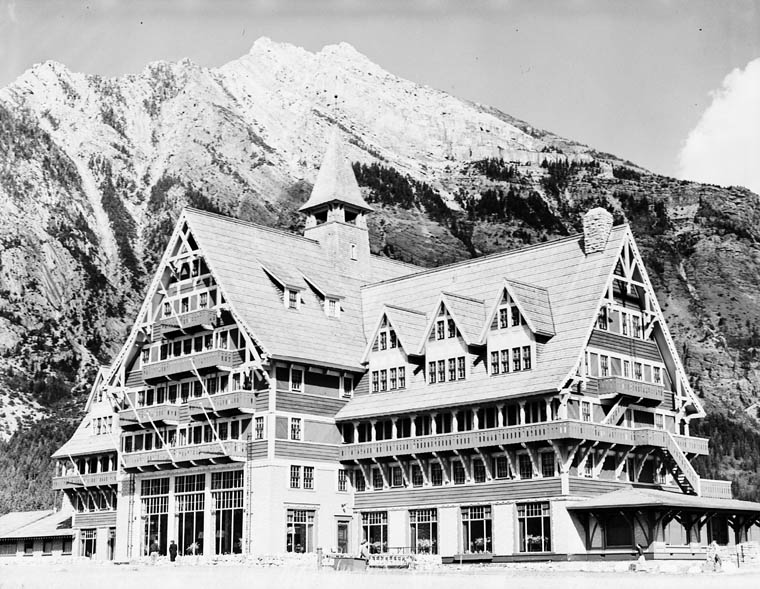
Prince of Wales hotel, Waterton Lakes National Park. (item 1)
Source: Library and Archives Canada

The hotel’s best-known ghost is that of a chambermaid named Sara, who reputedly worked at the hotel in its early years of existence and, after being spurned by her lover, threw herself off the fourth floor mezzanine to the lobby below. According to the book High on a Windy Hill: The Story of the Prince of Wales Hotel, Sara’s ghost has haunted the hotel ever since, making her presence known by “rattling liquor bottles and exhaling icy sneezes down the necks of wary guests.”

This story bears an eerie resemblance to a later incident, in which a gift shop employee named Mary committed suicide in a similar fashion in the late 1970s after having fallen in love with the hotel’s then famously dashing manager, Clifford Hummel, only to be turned down by him. According to the current manager, Mary leapt to her death from the sixth floor balcony wearing only a sheet, and to this day her spirit makes her presence known by pilfering and rearranging items in the hotel gift shop, something to which numerous employees have apparently attested.

While Sara and Mary are probably the hotel’s best-known ghosts, there are at least two others that allegedly haunt the corridors of the Prince of Wales. According to Budgen, a well-dressed gentleman who bears a strong resemblance to Abraham Lincoln is occasionally seen in the dining room and the basement, a ghost who announces his presence by way of a reflection in the windows and a distinct aroma of pipe tobacco. This is believed to be the ghost of a construction worker who fell to his death from scaffolding during the construction of the building.

Yet another ghost - that of the wife of a former hotel chef - began showing up in the common area of the hotel not long after the chef in question disappeared and was later found in British Columbia mysteriously without a wife. (The chef was apparently consumed with jealousy over his wife’s popularity with the hotel’s male employees.)

When asked about his own belief in the hotel’s famous spirits, Budgen, now in his third year as hotel manager, refuses to rule anything out. “I’m a skeptic at the best of times, but I’ve certainly been creeped out more than once,” he asserts. “There have been a couple of times where I’ve had to go out for a walk because I swear I’ve seen something. Mind you, all the creaks and gasps that this building makes doubtlessly contributes to this, but I’ve definitely smelled that smell of pipe tobacco - and then it disappears.”

Budgen also notes that he is not alone, and that a number of his employees have sworn they’ve seen something. “It happens to a lot of people here that they think they see things in the corner of their eyes,” he explains. “It happens to me, but I never see this sort of stuff anywhere else.”

(For more on the Prince of Wales Hotel, here is a link to an article I wrote on the hotel for the now-defunct Alberta magazine Legacy.)