Monday, 15 October 2012

On Bullying and Misogyny (In Memory of Amanda Todd)


The suicide of bullied Metro Vancouver teen Amanda Todd has generated yet another media frenzy over the epidemic of cyberbullying. In the case of Amanda, the 15-year-old from Port Coquitlam left behind a chilling YouTube PSA in which she recounts how her tormentors forced her to switch schools on multiple occasions (which did nothing to remedy the situation) and ultimately drove her to drugs, alcohol, seclusion and self-harming before ending it all. For those of you who haven't seen the video, you owe it to yourselves to see it.


The media's reaction to Amanda Todd's death has been depressingly predictable: outrage of the "How could this possibly happen?" followed by the predictable cacophony of proposed solutions to the epidemic of cyberbullying. As always, some called for increased policing of the web, others for greater bullying awareness campaigns in the school system. Some blamed parents and teachers for not doing more to stop it. Others callously opined that bullying is simply part of the natural order of things and that she got what she deserved. And as always, much of the focus remained on the need for teens to be careful while online lest they make themselves vulnerable to online tormentors.

The really depressing part, of course, is that Amanda Todd will soon be largely forgotten - apart of course from her grieving family and friends, who will never forget. And the frenzy of cyberbullying will quickly subside...until the next Amanda Todd pulls the plug on his or her life and the process begins again. And then of course there are the victims whose names and faces never make the pages of the National Post. Canada's youth suicide rate remains troublingly high. And while the rate is still higher for boys than for girls, the suicide rate for girls has jumped over the past few decades, while the rate for boys has decreased. There are thousands of Amandas out there. And far too many will leave this world unknown, with no YouTube account of their torment.

There can be no denying that the Internet, and social media in particular, has made the problem of adolescent bullying more insidious and difficult to combat. Not only does it allow perpetrators to remain anonymous, it also provides them with a far wider dominion over their victims. When I was a junior high schooler in the early 1990s, a change of school was generally a surefire tactic for curtailing bullying; while one still had to content with being friendless at a new school, at the very least it meant an escape from the devils of the old school. For modern-day teens like Amanda, changing schools offers no such escape. The web has even allowed her tormentors to target the girl's online memorials. Some sort of 21st century equivalent to the Greek Defixiones might be in order.

But while the 'cyber' element has made the problem of bullying scarier and more complicated, the root of the problem remains the same. Bullying is - and always has been - a societal means for maintaining a hierarchical status quo by punishing those who dare to overstep their bounds. It's also a means for placating the 'masses' with the occasional human sacrifice, playing into the dark side to our human nature. (Think Apocalypto in the schoolyard.) It's the 'mild' first-world tip of a very large and sinister iceberg that in other parts of the world manifests itself in the public lynching of gays and the spraying of schoolgirls with battery acid for having the audacity to seek out an education. And as always, those who fall outside of the default group (women, members of cultural, racial or sexual minorities, social misfits etc.) who bear the brunt of it.
"She flashed, felt repercussions, her own fault."
- Anonymous online commenter

The bullying of young girls like Amanda Todd is especially troubling inasmuch as it highlights the yawning gap between our society's post-feminist discourse and notions of equality and the harsh underbelly of misogyny that continues to contaminate our social relations. Granted, the Amanda Todds of the western world are no longer liable to be burned at the stake (as they might have been in Europe 500 years ago) or stoned to death (as she might well have been in modern-day Afghanistan or Somalia), but the horrible bullying to which she was subjected bears the same malevolent misogynist streak that motivated - and continues to motivate - such atrocities. The Amanda Todd story exemplifies the degree to which a great many men (and sadly many women) still view women within the passive virgin-whore dichotomy and consider those who lose their footing on that tightrope to be deserving of cruel censure.

So what are we to do about it? Sadly, there are no obvious cures. My own proposed radical solution for gender equality is not one that I'm expecting anybody to embrace anytime soon, namely a 50-year moratorium on male voting. Under such an edict, men would still be eligible to run for office but would have to be answerable to a female-only electorate (in a similar fashion to how chiefs and warlords within the Iroquois Confederacy were answerable to a council of women). A 50-year period would be long enough to produce profound change but short enough to remain within people's historical memory, a time period similar in length to the beginning and end of the Cold War, the rise of the Asian Tigers and the unfolding of the New Europe. And suffice it to say, 50 years of female rule would pale in comparison to 4,000 nearly uninterrupted years of patriarchy, but then again the goal is equality, not supremacy.

Getting back to the problem of cyberbullying, it bothers me that the onus is always placed on the victims to protect themselves against abusers while the abusers, and the complicit onlookers, invariably escape unpunished. While it is of course important for children and adolescents to be taught how to protect themselves online, it's about time more altruistic IT-savvy people stepped up to the plate and confronted this online terrorists head on. I was recently inspired by a story in the Guardian by Irish journalist Leo Traynor, in which he recounted his own tale of online abuse and how he enlisted a hacker colleague of his to track down his abuser - who turned out to be the son of a colleague with a head full of bad wiring. We need a Hackers Without Borders-type organization, a crack squad of angry nerds (who you would think would be natural allies in in this cause) to scare the crap out of would-be online tormentors.

At the same time, we need a 'coming out' campaign for former bullies seeking to make amends. In the aftermath of Amanda Todd's suicide, many commentors have come forward with their own stories of bullying and harrassment. For any sort of restorative justice to occur, those who are saddled with the burden of having been bullies or passive bystanders need to make themselves known, ask for forgiveness and then take part in combatting the problem. Just as the onus of gender equality cannot exclusively be placed on the backs of women, I don't see how anti-bullying campaign are to make any headway without the involvement of former perpetrators. At least one bully did just this in the aftermath of Amanda Todd's suicide. A good start, but far more of this is needed.

We should all be mad as hell about this - and about our society's ongoing contempt for women and girls who fail to meet mainstream culture's unspoken but understood expectations to be sexy-but-not-sexual, compliant to patriarchal strictures and vigilant in defence of their own purity. And for the sake of online freedom (and not ruining it for everybody else), we need to get tough on cyberbullies. Censoring the Internet will not curb bullying anymore than veiling and secluding women reducing instances of sexual assault, as conservatives in the Islamic world are fond of arguing. As a society we are capable of being better than this, but we won't get there without taking a long, hard look at the poisonous attitudes that persist within our supposedly progressive culture.

And for the love of god, please stop blaming social media for this! Yes, SM is a double-edged sword that makes the issue of bullying more complex, but it's not the crux of the problem. And besides, were it not for social media, none of us would be talking about Amanda Todd right now, as her excruciatingly eloquent YouTube statement could never have been made and disseminated around the world in the first place. Social media is not to blame for this. Misogyny and its never ending capacity to inflict unnecessary human misery is to blame.

In the meantime, my heart goes out to the girls family and friends, for what it's worth. Needless to say no words could ever even begin to take away the hurt.

Friday, 12 October 2012

Shit History Undergrads Say - Woodrow Wilson's 'Fourteen Pants'


Anybody who has ever worked as a teacher knows how mind numbing the marking process can be. Just about every teacher has his or her own strategies for plowing through a mountain of exam papers or essays without completely losing their mind. As a former TA in 20th Century World History at the University of British Columbia, I've had to endure many an evening slogging my way through booklet after booklet of verbose regurgitations of in-class notes on Vimy Ridge and the sinking of the Lusitania or, even worse, intensely morbid essays on war atrocities that relished in every gory detail like a Saw movie.

What was my coping strategy? Generally a combination of beer and derision, specifically combing through exam papers and essays for the egregious and comical abuses of the English language. We've all been guilty of this, of course. We've all been in the position where we're frantically scribbling away in an exam booklet in the hope of half-blindly stumbling on enough correct points to get a decent mark. The result is generally a cornuccopia of wounded sentences, awkward constructions, breathtaking run-on-sentences (runs-on-sentence?), tautological assertions, and just flat out bizarre factual statements.

Here are some particularly good ones that I've been hanging onto some over the years for my own amusement. This is what you get when you're grasping at straws or trying to fill an exam booklet as quickly as possible.

Syntaxed To Death

Diplomacy, apparently
Hitler achieved economic, military and physical growth.

Mao was married at the age of 14 but his wife died three years later. Then Mao had countless relationships with many children.

The Soviet Union used diplomacy to invade Poland.

Suspekt Speling

The Colombian Navel fleet was busy stropping American ships.

Wilson is most famous for his “fourteen pants” which outlined the steps he felt needed to be taken.

Pubic opinion on the subject has varied over the course of history.

Mathematical Genius

Mao Zedong and Adolf Hitler were considered one of the few greatest leaders that transformed their own countries in the early 20th Century.

In this way, both of them were one of the strongest countries in the Second World War.

Geography Fail

Japan resumed its expansionist policies, especially in the Middle East.

 
Going for Broke (a.k.a. Trying To Fill An Entire Exam Booklet)
More different than similar

Mao Zedong and Okonkwo [the main protagonist in Chinua Achebe's novel Things Fall Apart] were more different than similar in many aspects. Being from different cultures, this is to be expected. They share some similarities, but it is evident that these two leaders did things and thought things differently from each other.

Throughout history, there have been many great people, and many more unknown people. There have been many who have done wonderful things, and many who have done nothing at all. And every person has different attitudes towards everything around him or her, and it is these attitudes that shape actions.

You Don't Say!

Perception is crucial in understanding history.

Educated guessing is a large component of media writing as the future is still open to any number of possibilities.

Throughout history, many events have occurred which have greatly impacted the world. Such events are also bound to keep happening.

Hyperbolic Overdrive

In Japan’s case, the “two-two-six” rebellion is one such crisis that led to Japan’s involvement in WWII, and the subsequent history of the world.

Say That Again??

These comparisons of documents and accounts provide a number of questions about the reliability and reasoning behind such discrepancies in the comparisons, establishing an understanding of the lengths the Great Leader would go in order to attain freedom for his people.

The means Hitler and Mao used to achieve leadership roles were similar and different in different ways. Hitler used threat, secret police and democracy.

Similar....yet different

When juxtaposed on a comparative perspective, the methods Hitler and Stalin, of Germany and the Soviet Union respectively, implemented on their rise and solidification in power are very similar.

These two situations are similar in that they are opposite.

Stalin didn’t want to get his country involved with silly things such as world conquest.

As we live, we make history. The present is the history of the future, and the past is the future of our contemporary time.

Meanwhile, the Russia country was governed by the communist party under the Stalin Regime.

His views, albeit firmly believed, are often objective in regards to the external concerns, and only become prejudiced when the conflict strikes and internal locus.

When Nwoye [the protagonist's son in Things Fall Apart] becomes a Christian, he and his father fall apart.

This forced a period of hardship on the people triggering the despair of poverty, the anguish of war and the tragedies of death.

Just as in human nature, agreements on major events in history are fraught with inconsistencies, untruths and confusion.

[The soldiers in WWI] didn’t need or want absolutely anything else other than some food, rest, shelter, and most importantly, of course, not to end up dead.

Win!

The author writes his memoirs of his visits to the Front because the worm (or curiosity) of context got into his ahistorical apple.

Saturday, 6 October 2012

Music Review - A History of Now (Asian Dub Foundation)


I don't generally do music reviews on this blog. It's not its raison d'être and there are far better blogs out there for audiophiles than this one. But I couldn't resist doing this one. Not only was Asian Dub Foundation's latest album my audio highlight for 2011 but it was also an album which, for whatever reason, fell completely through the critical cracks. Virtually nobody reviewed it. Here's my review, for what it's worth.

I first fell in love with Asian Dub Foundation in the late-1990s following the release of their critical breakthrough album Rafi's Revenge. At that time of their emergence, the Indo-British collective occupied completely unprecedented musical territory with their idiosyncratic blend of punk, rapcore, dub reggae, drum 'n' bass and Indian raggas and their angry-yet-nuanced lyrics that touched on everything from anti-Asian racism in the modern-day UK to Britain's colonial heritage in India and the social problems that continue to plague the Subcontinent today. Many pegged the band for eventual stardom along the lines of the Beastie Boys and Rage Against The Machine.

http://kayleighroselewis.files.wordpress.com/2012/02/asiandubfoundation.jpg
From left: Martin Savale, Aktarv8r, Cyber, Chandrasonic, Al Rumjen, Sun-J
Somehow this never quite happened. After two critically acclaimed albums, ADF's iconic teenaged frontman, the elfin Bengali rapper Deeder Saidullah Zaman, left the band, leaving a hole that ADF has continually struggled to fill. The first post-Deeder album Enemy of the Enemy (the band's big anti-Bush statement in 2003) took the approach of a 'collective', featuring various people in the MC role. The disappointing 2005 album Tank introduced MC Spex into the leading role - an arrangement that didn't last long - while uneven but occasionally brilliant 2008 album Punkara introduced a twin MC format featuring rapper Aktar 'Aktarv8r' Ahmed and the punk-oriented vocals of former King Prawn frontman Al Rumjen, as well as memorable cameos by punk legends Iggy Pop and Eugene Hütz.

With all the personnel changes that the group has undergone in its 15-plus years of existence, Asian Dub Foundation has come to resemble a prog rock group along the lines of King Crimson or Genesis. Of the original six members, only three remain: guitarist Steve Chandra 'Chandrasonic' Savale and DJs Sanjay Gulabbhai 'Sun-J' Tailor and John 'Pandit G' Pandit. Enemy of the Enemy saw the introduction of percussionist Prithpal 'Cyber' Rajput whose dhol and tabla mastery gave the band far greater rhythmic depth, while Chandrasonic's brother Martin Savale eventually replaced Dr. Das on bass. As always, the new album features a lineup of guest artists, which this time around include female vocalists Shahla Kartouti and Kerieva, hip hop-influenced flutist Nathan 'Flutebox' Lee, string duo Chi-2 and a group of Cyber's own percussion students under the banner 'Ministry of Dhol'.

One reason why A History of Now received very little press was that the album was not paired with a tour - at least not in the western world. However, the new album was marked by a significant event in the band's history, namely its first ever tour of the band's motherland, a four-leg tour that began with an appearance at the Bacardi NH7 Weekender music festival in Pune in December 2010, will follow-up performances in Mumbai, Chennai and Delhi. ADF's first ever India may have set the tone for the new album, which provides some of the freshest, most energetic and most focused music we've heard from them in a decade.

The album's epic opener 'A New London Eye' establishes a fierce intensity that refuses to let up until the album's gentle eighth track 'Power of 10'. 'Urgency Frequency' is classic drum 'n' bass-heavy ADF that hearkens back to Rafi's Revenge, while 'London to Shanghai' is a charming 21st century travelogue underpinned by sampled Bollywood orchestra and Cyber's peppery tabla. The album's title track (a smart little song about digital media overload) features Aktarv8r at his verbal finest, while the subsequent 'Spirit in the Machine' (possibly the best track on the album) is a thundering instrumental jam featuring Cyber's Ministry of Dhol drummers and some steroid-fuelled riffs by Chandrasonic.

http://nh7.s3.amazonaws.com/indiecision/wp-content/uploads/2010/12/adf_002.jpg
Cyber, Sun-J and Chandrasonic at the Hard Rock Cafe in Mumbai
Other highlights on the album include the haunting, funereal 'In Another Life' (a number that evokes nighttime riverside funeral pyres in Varanasi) as well as the furious nu-metal-esque 'Futureproof', in which the band sounds like an Indian version of Pitchshifter. As is now ADF tradition, the album steers off for a track into decidedly un-Indian musical territory, this time into Tierra Latinoamericana with the Indigenous Resistance-themed 'This Land Is Not For Sale', featuring angry Spanish-language vocals from British-Roma vocalist Kerieva. And the album finishes with a decidedly un-ADF sounding piece of shoegazer dreampop reminiscent of Galaxie 500 or Cocteau Twins ('Hey Lalita'), possibly the closest this band has ever come to a bona fide love song.

It's not a perfect album. 'Where's All The Money Gone?' (Track 6) is probably the weakest number on the album, a retreat to the sort of tired leftist 'Occupy' platitudes that made Tank a less compelling album. 'Temple Siren' is a sludgy, slightly irritating statement on organized religion (or something like that) that doesn't quite hit the mark. But other than this, there is very little to fault the band on here. Among the few who have reviewed the album, some derided it for lacking the sort of undistilled anger that characterized their earlier albums. While this is unquestionably true, it's equally true that this is an older, more self-reflective band than the rage-fuelled sextet of Rafi's Revenge and Community Music. The big themes are still there but the lyrics are more philosophical and measured. And I'm inclined to think that they don't owe us anger all the time.

Even at their youngest and most petulant, Asian Dub Foundation always did an admirable job being even-handed in their political criticism. When criticized in some quarters for what was seen as focusing on anti-Asian racism and western imperialism while neglecting social problems within their own community, the band responded with '1000 Mirrors' on Enemy of the Enemy (memorably featuring Sinéad O'Connor as guest vocalist), a scathing indictment of misogyny and domestic violence in the Indo-Pak community. A History of Now carries on this tradition with 'In Another Life', an obvious commentary on poverty and caste in India. At the same time, their tireless solidarity with oppressed peoples around the world continues on with 'This Land Is Not For Sale', a track that will surely score them a continued following in Latin America.

There's more I'd like to see ADF do. While the band has notably stayed away from the Israel-Palestine conflict (and refreshingly refrained from any discernible Israel-bashing), it would be nice to hear ADF take a stance against Islamist extremists in the wake of cartoon and video controversies and continued religious violence in the Middle East. Coming from a band with a strong following on the ideological left and at least a couple of members of Muslim background, such a statement would pack quite a punch. I would also love to see these boys confront the enduring homophobia and LGBT discrimination within South Asia and the diaspora, particularly given recent moves by LGBT groups in India to push back the tide of homophobia. Guys, if you're reading this, those are my thoughts.

Requests aside, A History of Now is Asian Dub Foundation's strongest album in a very long time, both musically and lyrically. It's certainly their best material since Community Music - and certainly a more evenly excellent album than Enemy of the Enemy or Punkara. It's an album that points to a very bright future for these now-firmly middle aged Desi electro-Bhangra-punkers as they bang and riff their way into what looks to be a tumultuous decade both at home and around the world. This band's rediscovery of its old moxie is not a moment too soon. A revitalized Asian Dub Foundation might be exactly what this angry and confused world needs right now. ADF Zindabad!


Tuesday, 25 September 2012

Why Cookies By George Will Always Remind Me of Joseph Stalin


Before I begin, I should preface that this post is neither a foaming-at-the-mouth anti-capitalist rant, nor is it a glowing product or brand endorsement. I've gone both ways on this blog, but this is neither. This is simply a meditation on the strange permutations of brand association and the weirdness of nostalgia.

When Edmonton International Airport (my workplace since the end of July) opened a Cookies by George outlet a couple of months ago, I was utterly delighted. Cookies By George, for those of you yet unfamiliar with it, is one of the world's few food outlet chains about which I will readily wax poetic. Its much vaunted made-from-scratch gourmet cookies are without fail the baked good equivalent of a Tangerine Dream album - complete and total taste bud candy, or, to put it more crassly, food porn. My only fear is that I will be busting out of my pants in short order working in such close proximity with it.

In Soviet Russia, the cookie eats you!
There is, though, a dark side to my attachment to Cookies by George - one that causes me a certain amount of cognitive dissonance. As a history major at the University of Alberta in the late 1990s, Cookies by George was a weekly treat that preceeded an 8:30 am seminar class on 'Topics in Soviet History' led by Dr. David Marples, a man well known as one of the world's leading experts on the political convections of modern-day Ukraine and Belarus. Every morning I had this class (I think it was a Wednesday), I would grab a coffee and a couple of cookies from CBG in HUB Mall at the U of A and then settle in for three solid hours of discussion about the Gulags, the Purges, the Ukrainian Famine and Stalin's cult of personality with the caffeine and sugar spike helping to keep me wired and attentive.

The upshot of this is that since that time, everytime I've walked past a Cookies by George outlet, I've instantly been reminded of the 20th century's most murderous dictator. It's an unfortunate association, but I guess an inevitable one. Fortunately, for the sake of my own intellectual and moral clarity, the reverse does not seem to be the case and I seem to still be perfectly capable of reading a book or an essay on Stalin and being suitably repulsed by his reign of terror and carnage without starting to salivate with visions of milk chocolate chunk cookies in my head. Were this the case, I might consider therapy.

If any communications people from Cookies by George are reading this post, I don't really think this unfortunate product association is widespread. In fact I would be willing to bet that I'm the only person on earth who associates your company's products with Joseph Stalin. But it does make me wonder about the power of unintended brand associations. Much has been written about the potential hazards of juxtaposed images, such as the use of celebrity endorsements. This works very well if you're Rolex and you have Roger Federer and Rafael Nadal in your corner, but less well when you have Bruce Willis endorsing Seagram's Golden Wine Coolers, as he did shortly before entering rehab in the late 1980s.

Sometimes brands come under siege when they get caught up in major news events, as happened to both Adi­das and Dolce & Gabbana in 2009 when the former became associated with anti-government vio­lence in Iran and the latter with the notorious Australian crime matriarch Judy Moran. And then there's the case of Japan Airlines in the aftermath of the horrific 1985 crash of JAL Flight 123, which I discuss in my March 12 post on the communications consequences of the 3.11 disaster. In this case, the disaster triggered the slow decline of one of Japan's most iconic corporate brands in spite of the fact that it was shown to be in no way responsible for the disaster. In fact, with the Boeing company's faulty repairs to the 747 in question and the Japanese government's botched rescue efforts, it was undoubtedly the least culpable stakeholder - and yet it bore the brunt of reputational damage.

"Talk to the cookie 'cuz AHS ain't listening!"
By contrast, a strange association can sometimes do wonders for a brand or company. Returning to the subject of Edmonton-based cookie purveyors, Paradise Cafe and Bakery was a little-known baked good provider in Edmonton's downtown core before its profile was raised by a spectacular on-air kamikaze act by former Alberta Health Services CEO Stephen Duckett in late 2010 when he refused to speak to the press on the grounds that he was 'eating a cookie' in a display that was caught on video and quickly went viral. The Edmonton press were quick to find out where Mr. Duckett has purchased the oatmeal and raisin cookie in question, and Paradise did very brisk business for a while thereafter. Sometimes one person's triumph is more often than not someone else's triumph, but not always in the way you'd expect.

In the meantime, I will continue to enjoy Cookies by George's fine cookies, even at the risk of being reminded of one of histories worst villains. I wonder, too, if anybody else has any personal stories of strange product associations along these lines. I'd love to hear about them.

Wednesday, 19 September 2012

6 PR Lessons from the Golden Age of Piracy

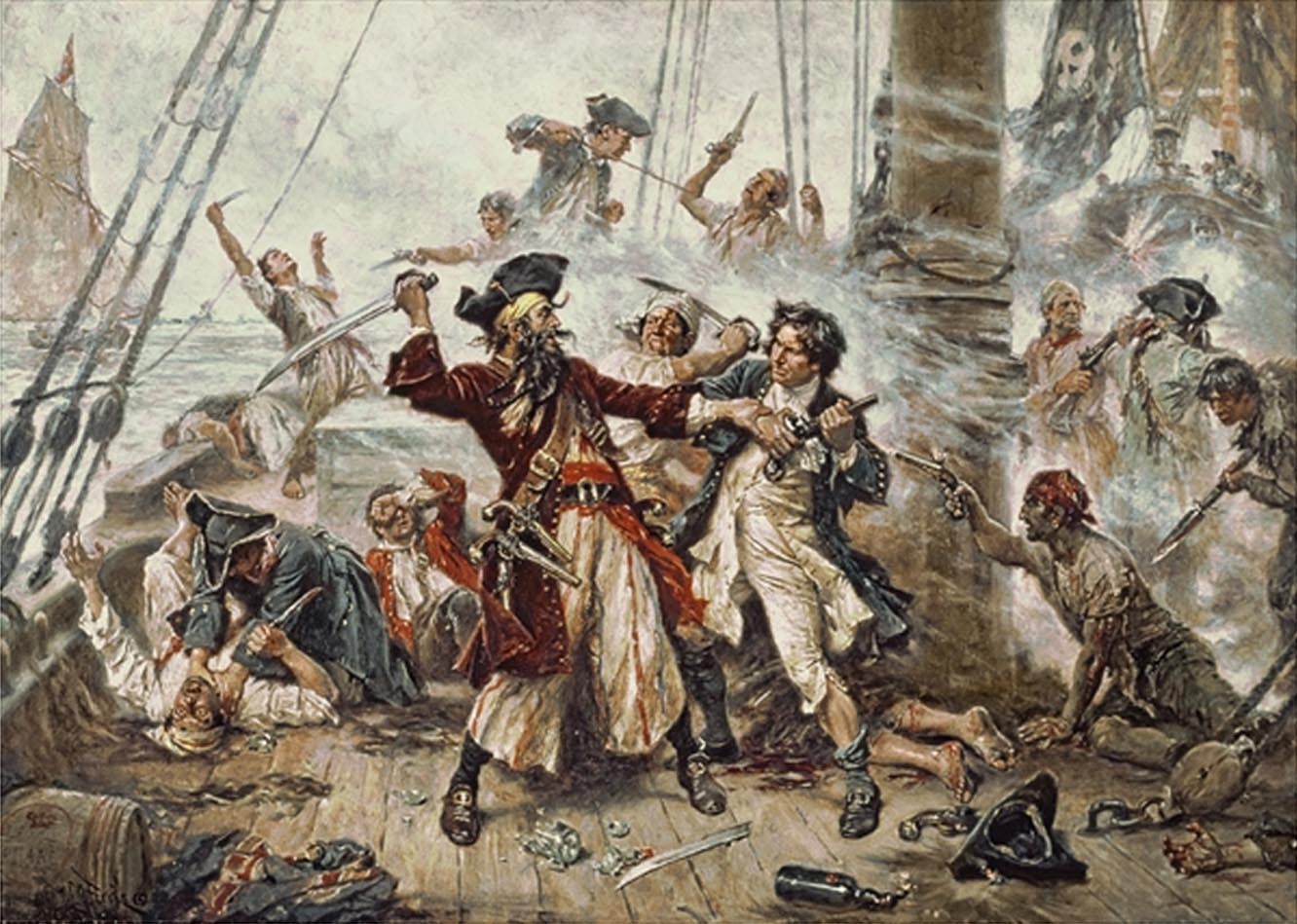
File:Capture-of-Blackbeard.jpg

Yarrrrrr!!! On the occasion of International Talk Like A Pirate Day I would like to share with you some of the most important communications lessons from age of Calico Jack, Captain Kidd, Blackbeard and other such scallywags.

The Golden Age of Piracy lasted roughly between the mid-17th to the mid-18th century, a time characterized by intense jockeying for imperial possessions in the New World between the leading Old World powers of the time - the Spanish, the Dutch, the French, the Portuguese and the English. The looting and plundering of the New World by these avaricious European monarchies meant that there was a great deal of gold and other loot in circulation, while the thin law enforcement capabilities of said powers meant a world of opportunity for skilled seafarers with a capacity for outside-the-box thinking and a taste for danger.

History also tells us that while a few of these pirates were indeed brutal sadists, the most successful tended to be canny communicators and concensus builders. John Rackham, better known as Calico Jack, owed much of his success to his ability to persuade captives to join his crew and more often than not let those who declined the privilege go free (after of course being relieved of their booty). Even the notorious Blackbeard (born Edward Teach), the epoch's most feared pirate, was known as an even-keeled buccanneer who never harmed captives as well as a shrewd negotiator who even managed to win himself a royal pardon - not long before he was killed by an anti-piracy mission led by Lt. Robert Maynard.

What, then, can be learned from these famous scoundrels within the domain of public relations? Here are six lessons on how to communicate, pirate-style.

1) Communicate your brand identity loud and clear.

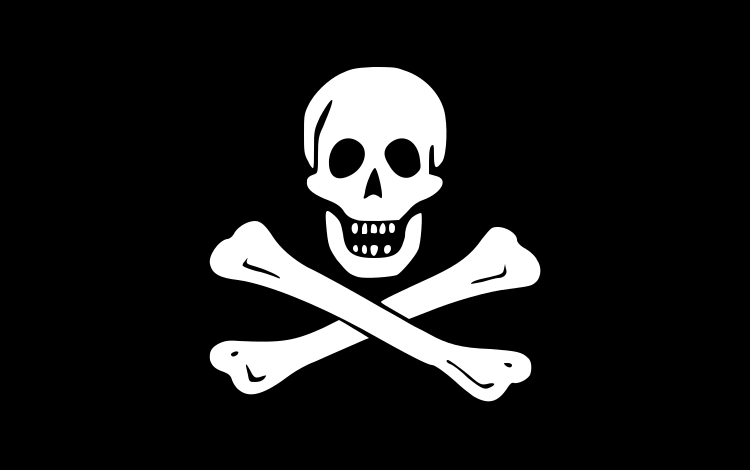
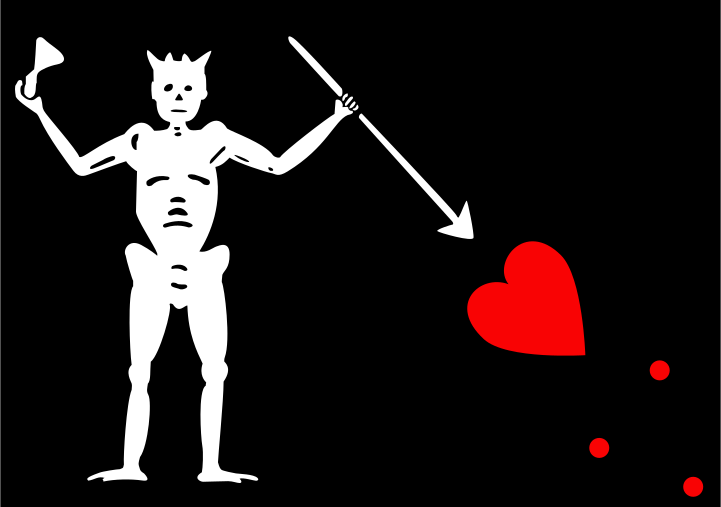
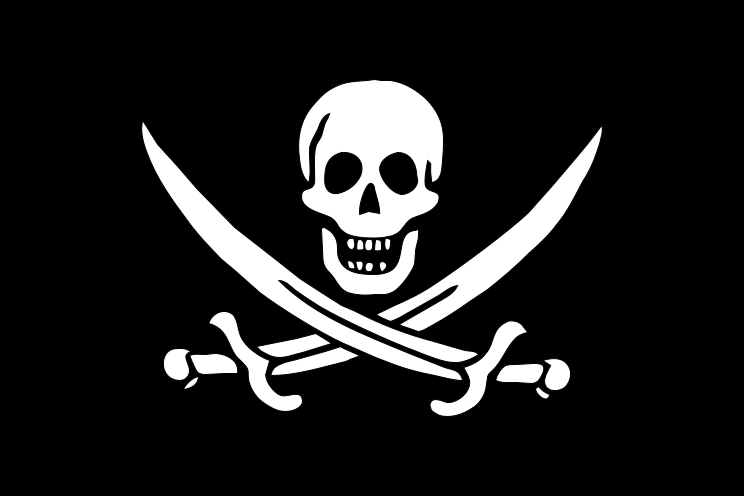
While the Jolly Roger flag consisting of a skull and crossbones is today the universal symbol of piracy, during the Golden Age any pirate worth his salt had his own variation of the Jolly Roger flag. Calico Jack's flag consisted of a skull and two crossed swords. The classic Jolly Roger was flown by 'Black Sam' Bellamy, while Blackbeard flew a black flag with a devil-type figure spearing a red heart. Identifying yourself as a 'pirate' wasn't sufficient. It made a difference which pirate you were - and your flag was your brand identity. A distinctive name also helps.

File:Flag of Edward England.svgFile:Pirate Flag of Blackbeard (Edward Teach).svg
File:Pirate Flag of Jack Rackham.svgFile:Flag of Henry Every red.svg

2) Be forceful - but not needlessly so.

While the epic pirate battles of the silver screen occasionally happened, these were the exception rather than the rule during the Golden Age of Piracy. Piracy was so common at this time that ship captains were generally insured against it, meaning that they would generally surrender immediately upon being attacked rather than risk loss of life and vessel. As such, the most successful pirates were those who could skillfully commandeer a ship, strip it of its valuables and disappear with minimal disturbance. As a PR practitioner, you want to do the same - make your appearance, transmit your message and ensure that the emphasis is on the message, not the messenger.

3) Do your research.

As many of the great pirates of yesteryear were Crown-sponsored privateers gone rogue, these guys generally had an excellent knowledge of the various captains and crews that plied the territories in which they did their work. For example, they would know who the truly sadistic captains were (and there were many in those days), the ones who made liberal use of the cat-o-nine-tails to instill fear among their underlings. In such cases, a pirate might make a more forceful play for the captured crew to jump ship and join the pirate crew - and probably string up their hated captain from the riggings for good measure. Similarly, a good PR pro should gain an intimate knowledge of a particular domain before 'sailing in'.

4) Don't neglect your internal publics.

For pirates of yesteryear, external stakeholders included the large commercial interests of the day, merchant captains with ships to be plundered and local governors and monarchs whose political and diplomatic largesse had the potential to make or break a pirate's career. But the more successful pirates also paid close attention to internal communication with their own crews. It was common among pirate crews of yesteryear to have bonuses and insurance policies against loss of limbs and other hazards of the job, and as such a pirate who had successfully avoided the hangman's noose could look forward to retirement on a Carribbean island someplace. As a professional communicator, much like as a pirate captain, your job involves good communication with staff so as to ensure 'smooth sailing' through potentially stormy waters.

5) Make sure you safeguard your information.

Contrary to what Hollywood films would have you believe, pirates very rarely - if ever - buried treasure on desert islands, nor did they make elaborate treasure maps. This myth stems primarily from the legend of Captain Kidd (who was in fact an amazingly incompetant pirate) and his supposedly buried treasure, and probably has no basis in reality. Plundered loot was typically safeguarded by pirate crews and banked with the assistance of pliant local officials. Making a treasure map that could easily disappear from a ship's maproom would be the equivalent of leaving computer passwords and other vital information out in the open for anybody to swipe. Not a good plan if you're looking to thrive in the piracy and/or communications business.

6) Be ready to fight when you have to.

Sometimes things do get ugly - and you need your tools at your side to fend off an attacker. In piratical terms, this means having a 48-gun sloop at your disposal, as 'Black Sam' Bellamy did, or expert swordsmanship and marksmanship, for which Blackbeard was famous. And as a professional communicator, this means being proactive and anticipatory with a veritable artillery of key messages and communications tools at the ready.

Monday, 17 September 2012

Neologism of the Week - Hyphoon

What's with the random comma in there? Unless you're going for Shatnerian inflection.


Back in January of this year I wrote a post on portmanteaus in which I highlighted ten of my favourite compound neologisms. These included such gems as 'momniscience', 'floordrobe' and 'botax', as well as my personal favourite - 'pornado' (the frenzied whirlwind of activity of a person desperately trying to cover up their Internet porn use upon being walked in on). Occasionally, however, I come up with my own gem, one of which I would like to share with you today.

One of my biggest pet peeves as a writer and editor is the misuse of hyphens. Hyphens are a useful form of punctuation, and indeed one that I employ fairly liberally in my own writing. However, they often employed wrongly and excessively, such as in the phrase 'thank-you', 'South-American' and 'badly-punctuated'. I personally think Marvel Comics is at least in part to blame for hyphen overuse. Why exactly does Spider-Man have a hyphen in it when Batman, Superman, Aquaman and Iron Man don't? Never made any sense to me.

Sometimes, however, hyphen misuse goes beyond an inappropriate one here and there are goes to crazytown. Case in point the photo hereabove, taken at one of the Occupy Wall Street protests in New York. There is so much wrong with the punctuation on this sign that it's hard to know where to begin, but certainly the most striking feature of it is the crazed explosion of unnecessary hyphens. Granted American liberalism has a prediliction for hyphen-based inclusivity (i.e. _______-American), but at leasy 'Arab-American' and 'Chinese-American' are correct usages. This, however, is bizarre and perplexing.

Which brings me to my neologism of the week, which is hyphoon. I think this requires little explanation. Moreover, as my good friend Yair Linn pointed out, this also works in French as tirade d'union, which, for the benefit of non-French speakers, is an amalgam of tirade (same as in English) and trait d'union, which means hyphen. Perfect!

I'm always on the lookout for new and interesting phraseologies and neologisms, and cool portmanteaus in particular. Please let me know if you come across any - or come up with a gem of your own.

Saturday, 15 September 2012

6 Reasons Why Everybody Thinks They're A Writer


Writers are an oft-depressed lot. Not only do they tend to spend a lot of time in isolation staring at a screen (and getting little physical activity), but they also have to contend with a world that by and large considers 'writing talent' to be about as rare and prized as right-handedness or an extensive knowledge of Internet porn. Writing, we are told, is not like, say, proficiency in graphic design, cardiology or jazz piano. In other words, it's something that given a high school education we can all do reasonably well.

As a professional writer and editor who has worked as a wordsmith of one sort or another for nearly a decade,I have always resented the notion that writing is somehow less skill-bound than other creative domains. While it is rarely spelled out to me so matter-of-factly as "Oh, anybody can write!" and indeed the praises of 'good writers' are often extolled, when it comes down to meeting production deadlines and cranking out copy, I have more than occasionally found my services bypassed on the pretext that "Well, we needed it done so we got Bob to do it, and you seemed busy. And Bob can do it just fine."

The problem with this rationale, of course, is that often Bob can't do it 'just fine'. Not that Bob is an idiot, or even a bad writer per se, but after eight years of wordcrafting and word-nerdery I am exactly the person you want to get those critical messages fine-tuned and positioned in exactly the right spots in the text, while ensuring that there are no awkward sentences, misplaced commas or references to 'pubic service'. (Trust me - I've seen it happen more than once.) Moreover, as a staff 'writer', it's my job to do this sort of thing, and the fact that I am appearing busy is not a reason to bypass me. After eight years as a professional writer, I work fast - and can get assignments done very quickly.

This is not to say that I'm the king of the written word, nor that I don't make mistakes. I've made more than my fair share in my writing career. I've committed egregious typos and acts of grammatical terrorism that have made it to print and still make me cringe today. (I won't give you specific examples because I hope to continue getting work with the publications in question, who I think haven't noticed yet.) I do go back and correct my blog posts, sometimes on numerous occasions. And even beyond this, I frequently think of better ways I could have phrased something after it's too late. (When it's too late? After it's too late sounds redundant doesn't it?) But I continue to get better with every year I spend doing this. As it is with brain surgery or plumbing, the more mistakes I make, the better I get at avoiding them.

But to return to the original topic, it is true that 'good' writing is often seen as something of a extra - not a frivolity exactly but a bonus that, while desirable, isn't of life-or-death importance. Which, to be fair, I suppose it is. After all, having a burst water main or a listeria outbreak at your airport is significantly worse than having a misplaced semicolon or a dangling modifier on the airport's web copy on shopping and dining offerings. And even if you're sticking to the creative professions, hideous graphic design on a pamphlet is invariably worse than convoluted syntax within the copy, as the graphic design in question will likely prevent readers from picking it up in the first place.

Nevertheless, poorly constructed writing will derail your communications, make your social media communication less effective and generally make your brand less good. And while I'm not saying that writing 'talent' is the exclusive purview of a certain noble breed of elected ones, it is the purview of people who have spent many years playing with words, sweating over syntax and generally fretting over crap that most people rarely think about. Us word people are not normal. Take one of us to a rock concert and our first reaction to the exultation "Rock on!" is to ask "On what?" Yep, we're freaks, but we're the freaks who keep your web and brochure content from going south,

Still, though, everybody on one level or another thinks they're a writer. Here is my personal theory on why that is.

1) We all do it in one form or another.

We write every day. We write grocery lists. We write angry letters to our neighbours for blasting Lynyrd Skynyrd out the window at 11:00 pm on a Tuesday. We help our children with their writing homework. And some of us write obnoxious blog posts purporting to explain why everybody thinks they're a writer. Not everybody fixes their car transmission on their own or designs a book cover. But everyone with a baseline level of literacy writes - and all the more so in the era of social media.

2) It's not generally taught on an extracurricular basis.

Writing isn't seen in the same light as, say, playing the violin or slam-dunking a basketball. And one important reason for this, I believe, is that with the exception of certain really nerdy kids, hardly anybody studies writing as an extracurricular activity - it's seen much more as a core subject that everybody learns. And the kids in writing clubs are probably mostly there to escape bullies; the writing is just a pretext.

3) Bad writing is often less immediately apparent than, say, bad music or bad drawing.

When a singer is hideously off-key or mangling the lyrics to the national anthem or something to that effect, it's generally quite apparent, as is egregiously bad visual design. Bad writing doesn't generally have the same effect. I suspect the reason for this is that at first glance writing on a page simply looks like writing on a page, and any badness therein does not become immediately apparent until you really, really read it. Which brings me to my fourth point, which is....

4) Most people don't really do that much reading.

Now before you protest, let me ask you this question. When was the last time you picked up a travel brochure at a tourist infocentre or on the brochure rack on a ferryboat and actually read the thing from start to finish - or even the lion's share of it? Unless we're actually sitting down to read a novel, most of us (and I don't necessarily exclude myself from this) are terribly lazy when it comes to actually reading and digesting the vast amount of content out there. This, I believe, leads to a devaluing - on some level - of the skills of the people who produce such content. But the fact of the matter is that without good copywriters, the key messages in boldface that you do actually pay attention to won't pop up, much to the detriment of the company in question.

5) Schools reinforce bad writing habits.

 PR Daily ran a great article recently on how schools inculcate really terrible writing habits among pupils. Such habits include shooting for length rather than conciseness, adherence to arcane grammatical rules like not starting sentences with the word 'and' (something I do all the time), and an unhealthy fixation on the introduction-thesis statement-body-conclusion structure. While these quirks in writing education don't necessarily undermine professional writers' respect out in the world, it does contribute to a general overconfidence in regards to writing know-how. "Oh, I know what the rules are." No, you probably don't.

6) Nowadays, everybody truly can be a writer - with a readership.

Thanks to Blogspost and other free blogging programs, anybody can start a blog. And many, many people do - including many who really shouldn't. No....I don't really mean that. In fact I think everybody should blog, because blogging on a regular basis is a great way to build up your writing chops and become the writer you know in your heart you could be. Because anyone can be a good writer. You just have to start out as a mediocre one and plod ahead.